By Jim Higgins, a former member of the European Parliament for Ireland (2004-2014)
The international community is confronting an increasingly complex Iran challenge—one that manifests differently across regions but stems from the same source. For the United States, it is a matter of security and strategic stability. For Europe, it is a test of energy security, terrorism, and human rights commitments. For countries across the Middle East, it is an existential question of regional interference and destabilization.
Yet across all these perspectives, one reality is becoming unavoidable: the root of the crisis lies inside Iran, and so must the solution.
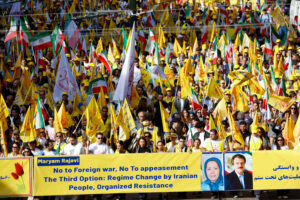
On June 20, more than 100,000 Iranians and their supporters are expected to gather in Paris. Hundreds of lawmakers and political figures from Europe and North America will join them. This is not simply a demonstration. It is a policy signal, reflecting a growing consensus that the time has come to rethink long-standing approaches to Iran.
That signal is shaped by events inside the country. In recent months, the Iranian people have paid a heavy price for demanding change. During the nationwide uprising earlier this year, thousands were killed and tens of thousands arrested. Now, in its aftermath, the regime has escalated repression through a renewed wave of executions to prevent another uprising.
Since mid-March, authorities have carried out political executions at an alarming pace—on average, one every other day. At least two dozen dissidents have been executed in recent weeks. Many were subjected to torture, denied due process, and executed in secrecy. Families are often informed only after the fact, sometimes summoned to cemeteries where bodies await them. In some cases, even the bodies are withheld, denying families basic dignity in death.
A significant number of those executed or awaiting execution are linked to the People’s Mojahedin Organization of Iran (PMOI), the principal organized resistance movement. This focus is not incidental; it reflects the regime’s own assessment of where the real threat lies.
When a government systematically targets individuals based on alleged affiliation with a specific opposition network, it is not merely suppressing dissent, it is acknowledging the existence of an organized alternative. The current wave of executions is therefore not only an act of repression, but also an admission of vulnerability.
This pattern is not new. In 1988, the regime carried out the mass execution of approximately 30,000 political prisoners, the vast majority associated with the PMOI. At the time, international silence was interpreted as acquiescence. Today, a similar moment is unfolding.
What distinguishes the current situation is that the regime has never been weaker, while the organized resistance has never been stronger. Over the past decade, networks associated with the PMOI have played a central role in nationwide uprisings. Even the regime’s own institutions increasingly acknowledge the presence of organized domestic opposition, rather than external threats.
This is why the events of June 20 matter.
The Paris gathering is the visible expression of an internal dynamic, an Iranian society that continues to push for change despite severe repression. It brings together not only the diaspora, but also policymakers who recognize that previous approaches, whether engagement or confrontation, have failed to resolve the crisis.
The Iranian people are striving for regime change, and to establish a democratic republic, and they are paying a steep price for it. The international community must decide whether to align its policies with that reality or continue pursuing approaches that ignore it.
A policy shift does not require external intervention. The role of the United States, Europe, and regional actors should not be to impose outcomes, but to recognize and support the forces already shaping Iran’s future from within.
This includes adopting measures that reflect the nature of the regime. Diplomatic and economic engagement should be explicitly conditioned on the cessation of executions and the release of political prisoners.
Equally important is political recognition. The National Council of Resistance of Iran (NCRI), a coalition that rejects both monarchy and the current theocracy, offers a framework for democratic transition. Its President-elect, Maryam Rajavi, has articulated a ten-point plan centered on fundamental freedoms, gender equality, and the separation of religion and state, principles consistent with Western democratic values. The NCRI has also declared a provisional government based on this framework, which merits serious engagement.
The choice facing policymakers is not between stability and change. It is between acknowledging an ongoing transformation or remaining tied to a status quo that is increasingly untenable.
The regime’s actions provide the clearest indication of what lies ahead. Governments do not execute young workers, suppress grieving families, and intensify repression unless they perceive a serious and immediate threat. The current wave of executions is not a display of strength; it is a signal of fear.
The voices of the victims do not end at the gallows; they echo far beyond—in the demands that will be heard in Paris on June 20.
For Europe, the United States, and the broader international community, the question is no longer whether Iran is changing. It is whether they are prepared to respond accordingly.
The answer will not be found in statements, but in policy.
And the clearest place to begin listening is Paris on June 20th.
Disclaimer: www.BrusselsReport.eu will under no circumstance be held legally responsible or liable for the content of any article appearing on the website, as only the author of an article is legally responsible for that, also in accordance with the terms of use.