By Derk Jan Eppink, a former Dutch MP and MEP
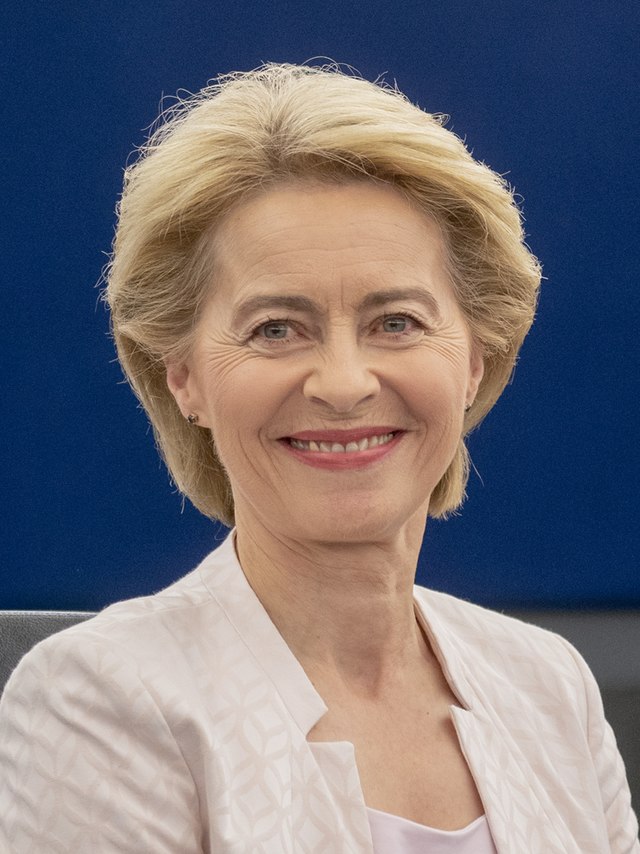
In the Berlaymont building in Brussels, the headquarters of the European Commission, President Ursula von der Leyen looks out contentedly over the European capital. As a German who has set her sights on historic missions, she is the ‘Queen of the Offices’, with her own little flat on the thirteenth floor.
For breakfast, she enjoys a latte macchiato with a croissant. In her private lift, she heads down to the official car in the basement, where her chauffeur is waiting. Her maiden name, Albrecht, sounds rather ordinary; she owes her commonly used name, Von der Leyen, to her marriage to a prince from a noble German family.
It seems as though Ursula von der Leyen holds the ultimate power in Europe. That is not the case. No single person, Member State or institution holds the ultimate power. There is a balance of power that is constantly shifting. Power in Brussels is relative, but there is one ironclad rule: a crisis is an opportunity to gain more power, because power stems from money. There have been – and continue to be – plenty of crises: the banking crisis, the climate crisis, the coronavirus crisis, the migration crisis and the Ukraine crisis. Crises arise – budgets follow.
Too much Marx, too little Hayek
Every crisis is met with an ‘EU rescue package’ which – to be serious – mysteriously always seems to amount to around 800 billion euros. Only the migration crisis remained a bone of contention in Brussels.
This crisis, of all things, poses the greatest threat to the old continent. The migration crisis is destabilising Western Europe from within at a time of economic stagnation that the EU has brought upon itself through its climate and energy policies. Too much Karl Marx, too little Friedrich Hayek.
De-industrialisation and poverty-driven immigration are eroding the foundations of the (Western) European economy: a toxic cocktail. The EU’s reflex: more money! Von der Leyen wants to increase the current EU multiannual budget of 1,200 billion euros to 2,000 billion for the period 2028–2034. The European Parliament is demanding 2,200 billion. In short: you ask, we deliver.
When bureaucracy dictates the economy, a planned economy is the inevitable consequence, with centralism at its core. The COVID-19 Recovery Fund (in EU parlance: NextGeneration EU), initially set at 750 billion euros – which rose to over 800 billion due to higher interest rates – became the long-dreamed-of ‘European joint loan’ on the capital market. It fell just short of being ‘Eurobonds’ because all Member States had to ratify it.
During the banking crisis, the European Central Bank (ECB) gained centralised power after ECB President Mario Draghi declared ‘whatever it takes’ in mid-2012. The presidency of the ECB is perhaps the most powerful position in the EU, currently held by the Frenchwoman Christine Lagarde.
Timmermans and Samsom
The European climate and energy policy of Frans Timmermans, then Vice-President of the European Commission, and his right-hand man Diederik Samsom, is now on the wane. According to the United Nations, the ominous global warming narrative had been exaggerated to apocalyptic proportions. The two socialists practised Marxist economics, packaged as environmental hosannas, and are in fact the architects of the current de-industrialisation and impoverishment.
A petty thief gets a criminal record; these megalomaniacal panic-mongers get off scot-free. Always be wary of the political alliance between the narcissist and the autist! The former peddles tear-jerking environmental tales, with himself in the spotlight, whilst the latter meticulously hammers together a doomed planned economy. The rest stand by and watch, as long as the budgets last.
From collegial to autocratic
Now, large sums are being channelled to the EU for ‘defence’. It is striking that parties which, after the fall of the Berlin Wall in 1989, generously spent the ‘peace dividend’ on other policy sectors – thereby weakening the Dutch armed forces within NATO – are now demanding large sums for military aid to Ukraine.
Had Western Europe remained a stronger pillar of NATO, this would have served as a greater deterrent to Russia invading Ukraine. Western Europe was virtually irrelevant, and the entire burden fell on the Americans, whom people are so keen to criticise. The EU now also wants to pursue a defence policy, but France and Germany recently pulled the plug on a joint fighter jet project due to ‘too much squabbling’.
This ‘bureaucratic centralism’ is reflected within the EU institutions. Initially, the European Commission’s leadership was a collegial system of commissioners who consulted one another, striving for consensus. This has gradually changed into a top-down structure. President Romano Prodi (1999–2004) was a conciliatory figure; his successor, José Manuel Barroso (2004–2014), was more presidential in style; Jean-Claude Juncker (2014–2019) was very affable after his first cognac at eleven o’clock (‘in the morning’). Von der Leyen marked the turning point: autocracy!
She makes decisions within a small circle and is the face of everything. Other commissioners are barely visible. Where on earth has Wopke Hoekstra got to? Vice-President Kaja Kallas has the disadvantage of coming from Estonia (population 1.3 million). She is overlooked on the world stage. Her American counterpart, Marco Rubio, refuses to speak to her. A commissioner from a larger Member State would be more effective.
The President of the European Council, the Portuguese António Costa, is a friendly man who smooths things over. Von der Leyen basks in the limelight and makes no secret of it – except when Donald Trump is sitting next to her. Then she looks like a frightened little bird.
🚨🇺🇸French MEP Sarah Knafo just destroyed Ursula von der Leyen:
"The only thing the European peoples expect from you now is your departure." pic.twitter.com/q7VlfxNNcW
— Mario ZNA (@MarioBojic) July 29, 2026
Europe lacks a Musk
Power lies not only in Brussels, but also with the member states. The problem is that two leading member states, Germany and France, are, like the rest of Western Europe, in the midst of a steep economic downturn.
In 2000, the European Commission launched a plan to make Europe the world’s most competitive continent. Europe was set to overtake America! That has failed. Between 2008 and 2023, US GDP grew by 87 per cent; European GDP by 13.5 per cent. In 2008, the EU accounted for 110 per cent of US GDP; by 2023, that figure had fallen to 67 per cent. The US has a far more productive and competitive foundation (raw materials, financial markets, tech companies) than the EU. America has an Elon Musk. Europe holds meetings.
Immigration is Western Europe’s biggest headache; Central and Eastern Europe have acted more sensibly. Germany and France are manoeuvring themselves into a tight spot. Elections are degenerating into verbal wars between the left and the right.
In Germany, three state elections are scheduled for September, with the opposition AfD in Saxony-Anhalt standing a chance of securing an absolute majority in the Landtag.
France is heading for a contest between a left-wing and a right-wing presidential candidate in the spring of 2027. The race is becoming increasingly bitter. German Chancellor Friedrich Merz has lost his bearings, whilst French President Emmanuel Macron has become a clownish figure, though he himself is unaware of it. At the same time, Spanish Prime Minister Pedro Sánchez is regularising over 1 million undocumented migrants, who, thanks to the Schengen Agreement, can travel on to other European countries. Von der Leyen, who has consistently criticised Hungary, remains silent on this matter.
The European Parliament has (finally) adopted the EU Return Regulation, which aims to process more asylum applications at the EU’s external border. The European Christian Democrats changed tack, abandoning the Socialists and the Greens, before striking a deal with the European Conservatives and Reformists (ECR) group to secure a majority. The European Parliament has finally woken up. A centre-right majority is now possible, but it is rather late in the day.
A cultural divide running right through Germany
The migration issue is dividing Europe. Eastern Europe does not want asylum seekers; Western Europe does, but fewer of them. That dividing line is, in fact, a cultural boundary. This boundary runs right through Germany, just as the Iron Curtain once did. The East is opposed to migration and the AfD voices that sentiment; the West has always supported asylum migration for historical reasons but cannot cope with the excessive numbers. A wave of attacks is sweeping across the country. Merz is caught between the two camps. He is visibly unnerved; he stumbled over a cabinet reshuffle and berated his own ministers.
The high-ranking ‘Queen of the Offices’ is driven by a ‘Wille zur Macht’ with grandiose plans, but in reality, it is the imagination that holds sway in Europe. L’imagination au pouvoir.
Originally published in Dutch by Wynia’s Week.
Disclaimer: www.BrusselsReport.eu will under no circumstance be held legally responsible or liable for the content of any article appearing on the website, as only the author of an article is legally responsible for that, also in accordance with the terms of use.