
By Ruben Cober
The European Commission engages in micromanagement whilst neglecting its core remit
The EU adopts hundreds of laws and regulations without any media attention. But some laws are so damaging to the European economy that they make the news. The new packaging law, which came into force on 12 August, is also illustrative of how the European Union and the European Commission are increasingly engaging in economic micromanagement, with disastrous consequences for the single market and businesses. The new rules are so complex, in fact, that the European Commission, which devised them, is now calling on people not to comply with them.
The Packaging and Packaging Waste Regulation (PPWR) is the new packaging law that applies across the EU (don’t click away – it’s getting interesting!). These rules are intended to reduce packaging waste, primarily through stricter requirements for the design, manufacture and use of packaging.
The new rules apply to anyone who sells, packages, imports or dispatches products. Millions of people and businesses will be affected by these rules. The EU has around 24 million small and medium-sized enterprises. 22 per cent of these sell goods via an online website or app. And a third of those sell goods across borders.
Companies that manufacture, use or import packaging must prove that it complies with European regulations by means of an EU declaration of conformity. However, as the Chamber of Commerce, amongst others, points out, ‘it is not yet entirely clear what the rules will mean in practice’. It is even unclear who is considered the manufacturer or producer. That is why the Dutch packaging industry organisation is calling for the situation prior to the law to be used as a basis. A sensible approach, given that the Commission proposed this law as far back as November 2022.
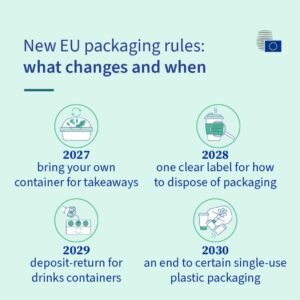
Other parts of the law will only come into force in the coming years. For example, from 2027 we will have to bring our own containers when collecting takeaway food, and by 2030 certain single-use packaging will be banned, such as that for sauces, fruit and vegetables, or small shampoo bottles in hotels.
Every EU official following me should read @lectronz damning indictment of PPWR.
"EU policymakers keep sounding the alarm about Europe’s lack of innovation, but seem hell-bent on making it as hard as possible for innovation to emerge at all."https://t.co/7aA81EsgzN
— Connor Allen (@ConnorAllenEU) August 25, 2026
One European law, 27 national authorities
You may already be thinking: perhaps an EU whose economy contracted in the first quarter should focus less on yet more rules and more on creating the conditions that enable economic growth. But it is even worse than that. The new rules undermine the functioning of the European single market, whilst promoting its functioning is, in fact, one of the European Commission’s core tasks.
The most controversial requirement of the law is that companies selling and shipping packaged goods to another EU Member State must register with that country’s ‘extended producer responsibility’ scheme. They are often also required to appoint a ‘local representative’, whom the local authorities can hold accountable. This is so that authorities can trace who is importing which packaging.
Despite there being a single European law, there is no single, overarching registration system for the whole of the EU; instead, 27 different registrations are required for each country. As if dealing with a single bureaucracy weren’t bad enough. This means that (small) businesses such as bookshops, wine merchants or smaller clothing shops wishing to export to other EU countries may face 26 separate appointments, 26 different deadlines, forms and costs.
Smaller retailers and online sellers report that the costs and complexity of registering across 26 national systems with 26 authorised representatives are prohibitive for them. The costs of appointing an authorised representative range from €600 to €2,000 per country. Failure to comply with the rules can result in sales bans and fines. In Germany, the law provides for fines of up to €200,000 per offence, although these will not apply until February 2027.
The European Commission now also recognises that its own legislation is so complex and is therefore even calling on Member States not to apply some of the rules. A senior EU official told the German newspaper Welt: “We know that the new rules present challenges for businesses and require changes. That is why we have published guidelines and frequently asked questions (FAQs). No one needs to stop exporting products at this stage. We are encouraging Member States not to apply the new rules and not to impose sanctions.”
The Commission also submitted a proposal in December that would suspend the obligation for companies to appoint a representative in every country. Better to turn back halfway than to go astray completely. However, these amendments still need to be approved by the European Parliament and the Council of the EU, and they cannot reach an agreement. The Member States have suspended their negotiations, and a first reading by Parliament, including relaxations, is not expected until October at the earliest.
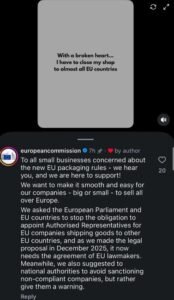
For dozens of companies, however, it is already too late. For instance, several small businesses and entrepreneurs have announced that they are stopping exports to other EU countries. The Commission responded to online posts with “we hear you and we are here to support”. Fortunately, with such a ridiculous legislative proposal, entrepreneurs do at least receive free moral support from civil servants.
The result: a law that was intended to reduce packaging waste, strengthen the single market and remove trade barriers has led to legal uncertainty, more trade barriers and fewer exports. This has become a recurring pattern with EU legislation and regulations in recent years: introducing complex obligations, then discovering that they are unworkable in practice, and subsequently quietly urging that enforcement be dropped. For some time now, the European Commission has been watering down or reversing its own legislation. This combination of unpredictability and the accumulation of complex rules with high compliance costs undermines confidence in the single market and makes it more difficult for businesses to add value to the economy.
The European Commission neglects its core task of the single market
The single market is already struggling. The single or common market is intended to make it easier for people and businesses to work, trade and invest across the EU. The single market is based on two principles. 1) Mutual recognition: if a product or service is approved in one EU country, it may also be sold in other EU countries without additional rules. 2) Harmonisation of rules: the EU draws up a common set of rules for products or services, so that the same standards apply in all Member States. This packaging legislation runs counter to this and actually makes it more difficult to trade within the EU, due to 27 different regulatory bodies.
In practice, the ‘single’ market is not at all that unified. There are still too many different rules, product standards and national exceptions that make trade in Europe more difficult and more expensive. The International Monetary Fund estimates that the costs of barriers such as those in the packaging law are equivalent to a 44 per cent levy on goods. We can continue to point the finger at unfair competition from China and the United States, but the EU is its own greatest economic enemy.
This legislation therefore fits into a trend in which the European Commission is neglecting or even undermining its core task of promoting the functioning of the single market. At the same time, the Commission is increasingly focusing on policy areas over which it has little say and where it merely supports the Member States. For example, over the past year the European Commission has presented, amongst other things, a ‘cultural compass for Europe’, an ‘Action Plan for Affordable Housing’, a ‘strategy for civil society’, and an anti-racism strategy.
In short, the European Commission is doing far too much at once, but far too little in policy areas where it has authority and can exert a positive influence. The European Union must stop looking for problems to solve, cease micromanaging the economy, and focus more on core tasks such as promoting the single market and providing solutions where it is actually able to do so.
Originally published in Dutch at the Substack channel of Ruben Cober
Disclaimer: www.BrusselsReport.eu will under no circumstance be held legally responsible or liable for the content of any article appearing on the website, as only the author of an article is legally responsible for that, also in accordance with the terms of use.