By Derk Jan Eppink, a former Dutch MP and MEP
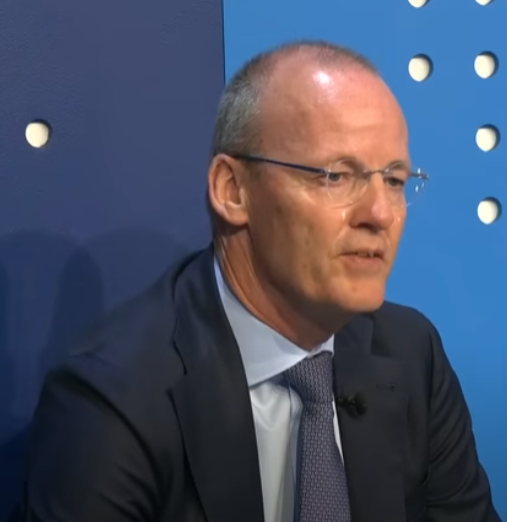
French President Emmanuel Macron has caused quite a stir with the idea that European Central Bank (ECB) President Christine Lagarde should step down early. The chickens are running in all directions. Every contender eyeing Lagarde’s position began to calculate. Among them is the former president of the Dutch Central Bank, Klaas Knot (58), who currently holds a less prominent position in the Netherlands as envoy for the construction of the Lely line*, in which multiple routes are being investigated.
The number of routes to a high position in the European Union network is usually limited. A candidacy should certainly not be launched too early, as political snipers are lurking in every corner. First of all, sufficient support is needed from the large member states, especially France and Germany, which requires careful manoeuvring. In addition, the most promising candidate must also fit into a “system of balances”.
A Tower of Babel
Knot knows these rules of thumb like no other. As president of the Dutch Central Bank, he sat on the Governing Council of the ECB in Frankfurt for fourteen years, first in a modest building but later in a huge headquarters towering far above Frankfurt – resembling a Tower of Babel. Also, far above the headquarters of the German central bank, the Bundesbank.
In 2019, many in Brussels noticed Knot’s interest in the presidency of the ECB, but that hope was thwarted by Macron himself. He launched an “appointment package” with the three top positions: Ursula von der Leyen as President of the European Commission, Belgium’s Charles Michel as President of the European Council, and Christine Lagarde as President of the ECB. Macron, then still promising, surprised everyone, including German Chancellor Angela Merkel. As an opponent of Eurobonds (the EU independently incurring joint debts on the capital market), Knot did not appear on Macron’s list: end of story.
Now the cards have been reshuffled. Macron is no longer the promising president but a whiner on his way out, in his final year. The French president looks clownish and his power is waning, but he wants to protect his “legacy” at all costs, with an inimitable move.
In the French presidential elections of April 2027, there is a possibility that the candidate of the Rassemblement National (RN) – Marine Le Pen (57) or her deputy Jordan Bardella (30) – will be elected president. Macron wants to protect his supposed legacy by having Lagarde, whose term ends in October 2027, step down early and replaced. Lagarde’s succession will then be settled well before the French presidential elections. A possible President Le Pen or Bardella would be cornered.
Macron’s role in Lagarde succession drama grips Europe https://t.co/7Y3iFCQV2O
— Roger Rosich (@rogeRosich) February 19, 2026
It is a striking move to solve French political problems at the European level in this way. But France sees the EU as a continuation of itself. Macron is taking Europe by surprise with this idea, and that is precisely the opportunity for Knot who, knowing his own kind, has shifted his position towards France over the years.
With regard to Eurobonds in particular, Knot has stated that he sees them as an instrument for financing defence expenditure. There is no majority in the House of Representatives for Eurobonds, but Knot argues that the Dutch parliament is “hyperventilating”. Evidently, this is well received in France. At the same time, Knot thinks that Eurobonds should not be used to pay off other countries’ public debts. The “new geopolitical situation” offers Knot the opportunity to curry favour in Paris. The most important thing of his strategy must be to prevent a French “non”.
Wavering Germans
The next question is: what does Germany think? The current coalition in Berlin of Christian Democrats and Social Democrats is wavering. Chancellor Friedrich Merz (CDU) wants to move to the right, but he is chained to the left by the German Social Democrats (SPD). In any case, the ruling coalition in Berlin is against Eurobonds.
Since Germany cannot put forward a candidate for the ECB because Ursula von der Leyen is already President of the European Commission, the Germans often see a Dutch candidate as an alternative. It is no coincidence that the first ECB President was Wim Duisenberg (PvdA). He was succeeded by Frenchman Jean-Claude Trichet. So far, “candidate” Knot fits the bill nicely.
Then come the bumps in the “system of balances”. What do other countries think? Since 1 January 2023, the eurozone has consisted of twenty countries. The Eurogroup, an informal consultative body of finance ministers, is chaired by Greek Minister Kyriakos Pierrakakis, who is, of course, a strong supporter of Eurobonds. The Eurogroup consists of informal consultations. That Greece obtained its presidency is mainly a sign that the eurozone has regained confidence in Greece. The Greek minister’s opinion is personal. He should be happy just to be there, after all the Greek fraud in the past. Italy usually keeps its cards close to its chest in order to get the most out of the trough, through a “quid pro quo” approach. Italians are pleasant dinner companions.
With Spaniards, it’s different. They bang their fists on the table and make a lot of noise, as if a big bull could appear at any moment. Spain demanded the presidency of the European Investment Bank (EIB) in Luxembourg, with Nadia Calviño, former Spanish Minister of Economic Affairs and a former senior official at the European Commission, as its candidate. Her opponent was Margrethe Vestager, former EU Commissioner for Competition. Spain found a strong ally in France, which remembered well how Vestager blocked a merger between France’s Alstom and Germany’s Siemens. A European Commissioner for Competition is bound to make many enemies. But for Vestager, that was one too many. The result: a resounding “no”.
Christine Lagarde is expected to leave the ECB before her term ends, paving the way for Klaas Knot to succeed her as president, according to a Bloomberg survey of economists https://t.co/rjUbI1zZMG via @jrandow pic.twitter.com/aOgFWMclPG
— Zoe Schneeweiss (@ZSchneeweiss) February 25, 2026
Compensation for Spain
Knot must, of course, prevent such a situation, although Spain also has a competitor in the ECB in the person of Pablo Hernández de Cos, former governor of the Spanish Central Bank (2018-2024) and, since last year, General Manager of the Bank for International Settlements (BIS) in Basel. Spain, especially the current socialist government, will start “pushing” again, even though it has already secured a high position with Calviño.
Prime Minister Pedro Sánchez may talk big, but he is doing nothing for Ukraine, while legalising 500,000 illegal immigrants in Spain, much to the dismay of other European countries. These people are free to travel through the Schengen area. This does not earn Spain any favours. Ultimately, the European system will have to offer Spain some “compensation”, if only to save Spanish honour. But the gift will not meet the standards of Saint Nicholas. As long as Germany supports Knot and France is not too opposed to him, lesser gods can be “bought off”.
Conclusion
Even under Knot, the ECB will continue to develop into a European cash machine, instead of complying with its original task: stable monetary policy. Conclusion at this point: in the current situation, Knot fits into the monetary picture in terms of Eurobonds; he remains standing in the system of Franco-German balances and should be able to overcome remaining hurdles, such as those in Spain.
Nevertheless, a profit warning applies. Knot cannot count his chickens before they hatch, because at any moment, Macron could decide not to go ahead with it.
Originally published in Dutch by Wynia’s Week
Disclaimer: www.BrusselsReport.eu will under no circumstance be held legally responsible or liable for the content of any article appearing on the website, as only the author of an article is legally responsible for that, also in accordance with the terms of use.