By Michael Landl, Director at the World Vapers’ Alliance.
Every year on 31 May, the WHO marks World No Tobacco Day. This year, the campaign targets nicotine and tobacco as a single problem and calls for tighter restrictions on vapes and nicotine pouches. One day earlier, on 30 May, the world marks World Vape Day. The timing is deliberate. So is the disagreement.
The WHO has been running this playbook for years. Every World No Tobacco Day, the same message: nicotine is the enemy, alternatives are industry tricks, and anyone who disagrees is in the pocket of Big Tobacco. The result is a global policy environment where governments feel empowered to restrict the very products that are helping smokers quit, while cigarettes remain freely available on every street corner. Eight million people die from smoking every year. The WHO’s response is to make it harder to access less harmful alternatives. That is not a public health strategy. It is a failure dressed up as one, and consumers around the world are paying for it with their health.
This World Vape Day, consumers in Germany, South Africa, and Argentina are standing up for the right to a less harmful alternative.
This #WorldVapeDay, the message is simple: One Switch, Everyone Wins. New Ipsos polling for @innovationweare backs it up. Switching to less harmful alternatives not only benefits the smoker but also improves loved ones' lives.https://t.co/9hApFePgW4 #WVD26
— Michael Landl (@LandlMichael) May 27, 2026
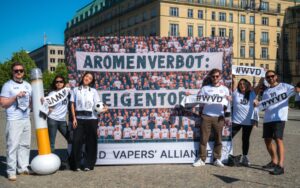
In Berlin, vapers and smokers protested together against Germany’s planned ban on flavours for e-cigarettes. The German government wants to remove the one thing that makes vaping work for most people who use it to quit. Adults who switch to flavoured e-cigarettes have 230 percent higher odds of quitting than those using tobacco-flavoured products. When Canada introduced a similar ban, cigarette sales went up by nearly 10 percent. In the Netherlands vaping among minors more than doubled, from 3.7 to 7.6 percent, just one year after the introduction of a flavour ban. Overall, cigarette consumption increased. 27 percent of former vapers reported smoking more or having started smoking again after the ban. Germany knows these numbers. It is pressing ahead anyway.
In South Africa, consumers spoke up against a tobacco bill that, despite some concessions, is being driven by a health minister who has publicly dismissed harm reduction as a flawed premise. South Africa has one of the highest smoking rates in the world. The answer to that is not to treat a nicotine pouch like a cigarette. It is to give smokers a real way out.


In Argentina, the story is more complicated. After 15 years of prohibition, the government finally did what consumer advocates, including the World Vapers’ Alliance, had been pushing for: it legalised vapes, heated tobacco products, and nicotine pouches. That is a genuine step forward and it matters. Prohibition did not make nicotine disappear. It just pushed millions of Argentinians into an unregulated black market. Recognition of that reality is progress. But the new framework still includes a ban on flavours. Argentina has taken one step forward and half a step back. The flavour ban needs to go.
Happy #WorldVapeDay from Argentina! One Switch, everybody wins. Argentina has taken the first step by legalising less harmful nicotine alternatives. Now more countries must follow. Find all #WVD26 info here: https://t.co/fiv8CT3sk9 pic.twitter.com/muRHgJo9JL
— Michael Landl (@LandlMichael) May 27, 2026
Three countries. Three different political contexts. The same underlying problem: policymakers treating nicotine and smoke as the same thing, and smokers paying the price.
This is also happening at the EU level. The European Commission’s evaluation of the Tobacco Products Directive largely sidesteps the evidence on harm reduction. Additionally, some Memeber States and the Commission are pushing for vaping taxes that, as research consistently shows, reduce vaping and increase smoking. The WHO’s World No Tobacco Day campaign calls vapes and nicotine pouches industry tactics designed to hook a new generation. It calls for flavour bans and tighter restrictions on the tools that have helped millions quit.
The countries that have actually cut smoking did the opposite. Sweden is smoke-free. The UK halved its smoking rate. New Zealand cut smoking among under-25s to around 3 percent. None of that happened through prohibition. It happened because smokers were given honest information and real alternatives.
When a smoker switches completely, the benefits go beyond themselves. Secondhand smoke raises children’s risk of asthma, pneumonia, and bronchitis. Maternal smoking causes low birth weight, preterm birth, and stillbirth. Children of smokers are up to four times more likely to become smokers themselves. One switch changes all of that.
That is what World Vape Day is about. Not industry. Not flavours as a marketing tricks. People who smoke and want to stop, and the evidence that shows what actually helps them do it.
The WHO will spend World No Tobacco Day telling the world that nicotine is the enemy. The consumers in Berlin, Johannesburg, Buenos Aires, and everywhere else know that smoke is.
Disclaimer: www.BrusselsReport.eu will under no circumstance be held legally responsible or liable for the content of any article appearing on the website, as only the author of an article is legally responsible for that, also in accordance with the terms of use.