By former Dutch MP and MEP Derk Jan Eppink
It has often started in Paris
Revolutions follow their own logic. Ruling elites usually meet their downfall whilst dancing. French President Emmanuel Macron seems destined for that fate. During the chaos in Paris last weekend, he danced merrily with his wife at Céline Dion’s concert. When asked where the president was, there was only one answer: ‘Monsieur le Président, il danse’.
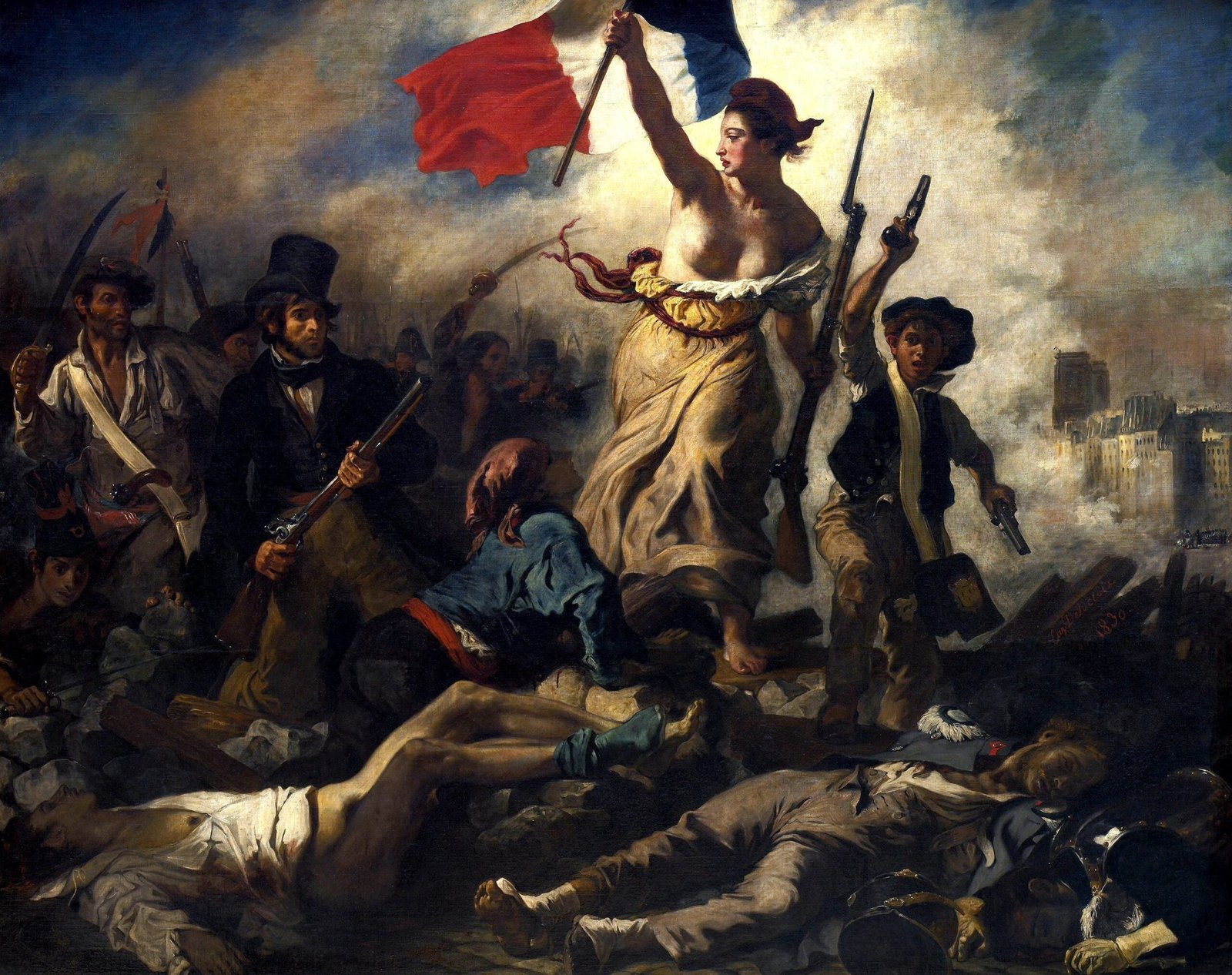
Europe has witnessed many revolutions; not infrequently, they began in Paris and spread to other countries. On 18 April 2027, there will be presidential elections in France. Spain has parliamentary elections on 29 November this year; Italy will go to the polls next year. Germany has a number of state elections, such as on 25 April 2027 in neighbouring North Rhine-Westphalia.
The European Union can cope with an unfavourable election result in a Member State, but France is ‘in a league of its own’. And certainly when it comes to political street violence. The fear that a possible victory for Marine Le Pen could lead to a form of civil war is not unfounded. The radical left will not accept that result and will take to the streets. The police cannot cope, and the army is the last resort.
Islamo-socialism
France is in revolt and Germany is locking itself into a political impasse. Chancellor Friedrich Merz has lost his way and is losing all credibility. German humour is limited, but he comes across as a clown. His CDU is being completely overtaken by the right-wing Alternative for Germany (AfD) but rules out any cooperation with that party. Merz is thus a prisoner of the left, just like his coalition partner, the Social Democratic Party (SPD), which is simultaneously colluding with the far left – both the Greens and Die Linke.
Both situations share two common causes: a domestic shift in power brought about by excessive immigration, and an unaffordable energy and climate policy that is causing the economy to stagnate. More people sharing a smaller pie.
On 21 January 2015, I wrote a column in de Volkskrant entitled: ‘Islamo-socialism is exploding in the streets of Europe’. This was in the wake of countless attacks in Paris and Brussels. Such a headline would no longer be permitted today, at least not in de Volkskrant. Nevertheless, the problem has grown. What is the crux of the matter?
Socialist parties were losing more and more support, particularly from lower-income voters, who began casting protest votes for right-wing parties such as the Le Pen family’s Front National at the time. To compensate for this loss of votes, socialist parties sought support amongst the growing Muslim electorate and adapted their rhetoric accordingly.
Excessive immigration tapped into a new source of votes. Secular socialism became somewhat more Islamic (less Marx, more Allah), and thus Islamo-socialism emerged.
As green parties grew, they too became part of this mix. In French, one might speak of ‘Islamo-gauchisme’. This occurred in countries with a large and growing Muslim community: in France, Germany, Belgium and also in the Netherlands.
Anti-Zionism and anti-Semitism
In the Netherlands, left-green formation “Pro”, too, is the result of such a construct: the social democrats of the PvdA were effectively swallowed up, and the GroenLinks faction effectively seized power. In France, this is Jean-Luc Mélenchon’s La France Insoumise (LFI), a socialist from the Stone Age. Second in command in the party is Rima Hassan, a French-Palestinian activist who questions Israel’s right to exist. In Germany, it is Die Linke, the right-wing successor to the communist ruling party in the GDR, which now aligns closely with the Greens. In recent elections in Berlin, half of Die Linke’s voters were Muslims.
Such a symbiosis requires a common denominator in its culture of struggle. This became ‘anti-Zionism’ and ‘anti-Semitism’. This is the ideological connective tissue of the ‘Islamo-left’. In major Western European cities, such as Amsterdam, Jews are at risk.
The ‘Muslim view’ of Jews is essential for socialists and Greens as a basis for legitimising their electoral gains. In this way, the secular left in Western Europe is Islamising itself, a trend also evident in Pro. That party has become anti-Israel, despite the Jewish roots of the PvdA. The ‘Islamo-left’ is united by the Palestinian flag; even Greta Thunberg waves it.
In France, the presidential elections may well turn into a contest between the nationalist right and ‘Islamo-leftism’, with the loser refusing to accept the result. The violence of recent weeks has shown how quickly that division can escalate. If necessary, a state of emergency must be declared in major French cities.
The Italian Prime Minister, Meloni, immediately deployed the army during similar riots in Milan. Soldiers dispersed troublemakers with batons, thereby protecting Milan’s cathedral, the Duomo. She took action whilst Macron was dancing. Meloni has already scored points for the upcoming elections with her firm approach.
🇫🇷 #France | Betting markets suggest:
1️⃣ Le Pen remains the favourite, but her momentum is fading following the deadly attack in Trappes.
2️⃣ Lisnard is extending his lead over Mélenchon and gradually closing the gap with Philippe, particularly on Polymarket, where trading… pic.twitter.com/BCCpqlIqvL
— Christophe Barraud 🇫🇷 🇲🇨 (@C_Barraud) October 25, 2026
Party ban
The German Christian Democratic sister parties, the CDU/CSU, have painted themselves into a corner. They refuse any contact with the AfD; they cannot even bring themselves to say ‘Guten Tag’. The CDU/CSU is entirely at the mercy of its coalition partner, the SPD, which is, however, under threat on its left flank from the Greens and Die Linke.
These parties are even demanding a ban on the AfD, because the AfD is pulling Merz to the right, whilst the SPD is pulling him to the left. The result is political gridlock and economic stagnation. Germany’s once-thriving industry has practically ground to a halt, companies are leaving and Germans are losing their self-confidence.
Spain is holding general elections on 29 November following the resignation of the socialist Prime Minister, Pedro Sánchez. He, too, staked his political future on attracting Muslim votes and decided to legalise 500,000 undocumented migrants. That figure actually rose to 1.2 million, whilst unemployment among Spanish young people under the age of 25 stands at 24 per cent. So there is already massive youth unemployment. The real reason is the importation of a new electorate.
Sánchez, however, made a blunder when Ceuta, a Spanish enclave in North Africa, was stormed by around 50,000 North Africans, mainly Moroccans. He visited the enclave, was jeered at and immediately went on holiday. A visit by the Spanish king was intended to calm the situation.
In the general election, the conservative Partido Popular (PP) and the even more conservative Vox stand a good chance of taking the helm. Vox’s support base lies mainly in Andalusia, and its three slogans are: patria, familia, reconquista. Clear language.
Protesters in Barcelona, Spain looted shops and set fire to street furniture around the city’s central Plaza de Catalunya in an anti-establishment rally on Saturday.
Europe is facing a wave of public anger, with demonstrators protesting over housing and living costs across the… pic.twitter.com/YSWgWiI2Vh
— CBS News (@CBSNews) October 25, 2026
‘We told you so!’
What are the consequences of this situation? As soon as France finds itself in a power vacuum, for whatever reason, interest rates on the national debt will rise. This debt amounts to no less than 120 per cent of GDP. France is fortunate – though this is no coincidence – that the President of the European Central Bank (ECB) is French: Christine Lagarde. France will become the biggest problem, but a depressed Germany will be not far behind. In both countries, the Dutch concept of ‘poldering’ is not particularly well known.
The Americans will be watching with a look that says: ‘we told you so!’ In February 2025, during the Munich Security Conference (at the Bayerischer Hof Hotel), Vice-President JD Vance delivered a scathing speech to European leaders on the consequences of excessive immigration. The audience of old-school establishment figures was shocked. America will now say: sort it out for yourselves.
“I believe that within my lifetime, within the next ten, 20 or 30 years, we will see an episode resembling a civil war.”
The son of former French president Nicholas Sarkozy, Louis Sarkozy says if Marine Le Pen is elected the next leader of France then “every left wing party,… pic.twitter.com/OlwW3nXIWT
— Times Radio (@TimesRadio) October 26, 2026
Zelensky takes the hit
The biggest casualty is the Ukrainian President Volodymyr Zelensky. The Americans regard him as a ‘stumbling block’ and are scaling back their support. Zelensky is therefore turning to the EU countries: 70 billion euros! Western European countries are running out of money themselves. Earlier this year, Belgian Prime Minister Bart De Wever suggested talking to Russia, because Ukraine ‘cannot win the war’.
There are few reasons for Russian President Vladimir Putin to make concessions. The ripe apple falls from the tree of its own accord. The EU can only negotiate from a position of weakness, as France is at loggerheads with itself and Germany is adrift.
Never mind! Ursula von der Leyen, President of the European Commission, has presented an ‘ambitious’ European multiannual budget: 2,000 billion euros! Let’s just wait and see what Europe looks like after the French presidential elections.
Originally published in Dutch by Wynia’s Week.
Disclaimer: www.BrusselsReport.eu will under no circumstance be held legally responsible or liable for the content of any article appearing on the website, as only the author of an article is legally responsible for that, also in accordance with the terms of use.