By Hannes Hólmsteinn Gissurarson. Professor Emeritus of Politics at the University of Iceland
In the referendum on 29 August 2026, Iceland rejected negotiations on EU membership for five reasons: three economic and two existential. First, the choice was not between isolation and Europe. Iceland had been a member of the European Economic Area since 1994, alongside Norway, Liechtenstein, and, for practical purposes, Switzerland. This meant Iceland was part of the Single Market, while fisheries, agriculture, foreign trade, and monetary affairs were not under EU control. Secondly, the Icelanders did not want to cede control of those four important sectors to the EU, especially their sustainable and profitable fisheries, and to lose the possibility of making free trade agreements with countries such as China, India, the US, and Brazil. The third economic reason was that prosperous Iceland would contribute much more to the EU than it would receive from it. The Icelanders were not amused when Politico quoted an EU official who said he hoped Iceland and Montenegro would join at the same time because the gain from Iceland would cover the cost from Montenegro.
Iceland: European Union membership negotiations referendum 🇮🇸 #Iceland
Icelandic voters have rejected reopening EU accession negotiations. The final result:
Yes: 47.17%
No: 52.83%Explore: https://t.co/AoULaq5ZGj pic.twitter.com/iNQtg1XP6t
— Europe Elects (@EuropeElects) August 30, 2026
EU’s Prospects
One existential reason for the membership rejection was that the EU’s prospects seem less than bright. It faces significant financial challenges in the near future: unfunded pension liabilities, whereas the Icelandic pension system is the world’s strongest; persistent government deficits in many member countries; substantial planned spending on military capabilities, whereas Iceland has a defence treaty with the US; and the inevitable cost of the nine relatively poor applicant countries in Southeast Europe. Despite these challenges, the Brussels elite is trying to turn the EU into a federal state, against the wishes of most European voters.
Strong National Identity
Another existential reason may explain why the Icelandic Right and Left united against EU membership, with support for the EU largely confined to urban intellectuals and public employees. This is the strong Icelandic national identity forged in the nineteenth-century struggle for independence, culminating in Denmark granting Iceland sovereignty in 1918. This identity was further strengthened by the four cod wars Iceland fought until 1976 to gain control of the fertile fishing grounds surrounding the island. This national identity rested on the memory of the independent Icelandic Commonwealth of 930–1262, governed by law rather than a king, as well as on the memory of the dark age that followed, when Iceland had to succumb first to the Norwegian and then the Danish king. Unsurprisingly, some of my colleagues at the University of Iceland, such as Professors Baldur Thórhallsson and Gudmundur Hálfdanarson, who have been generously funded by the EU, have done their best to disparage and even mock this memory.
‘They want to have control of their own future.’
Iceland’s Former Minister of Foreign Affairs Gulli Thor Thordarsson explains why his country has rejected resuming negotiations to join the EU. pic.twitter.com/GkD1QvlJI3
— GB News (@GBNEWS) August 30, 2026
Clever Slogan
These five reasons not to join the EU were presented in a well-organised and almost flawless campaign by the No-sayers. The Yes-sayers, on the other hand, relied mostly on one clever slogan, Já til ad sjá, which is difficult to translate into English. In an admirably concise way, it really means: Vote yes to find out what the EU can offer Iceland in negotiations. Who could be against this? Only those who had read the detailed EU instructions for applicant countries, of course.
Vicious Personal Attacks
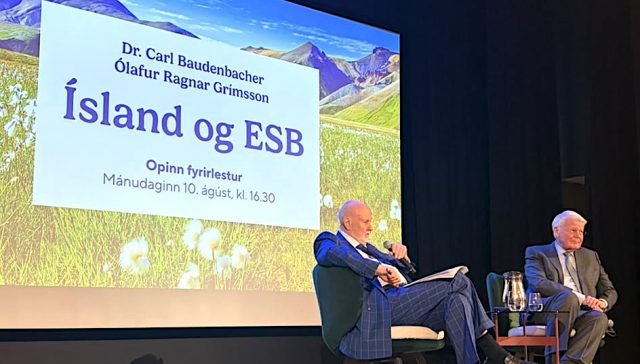
The Yes Camp also relied on three ploys. One was to promise a much higher standard of living if Iceland joined the EU than the one it already enjoyed. This was unconvincing in a country much more prosperous than most EU countries. The second ploy was to make US President Donald Trump an issue. This did not fly, either. Reckless remarks by a president who has only two and a half years left in office do not change a nation’s long-term foreign policy. The third ploy was vicious personal attacks on the two most effective spokesmen for the No Camp, Dr Carl Baudenbacher, an internationally acknowledged expert on European Law, who, as President of the EFTA Court in 2013, had found for Iceland in an important case about liabilities stemming from the 2008 Icelandic bank collapse, and Ólafur Ragnar Grímsson, who had been president of Iceland for twenty years, 1996–2016. Dr Baudenbacher published a book on Iceland and the EU and gave a lecture to a packed meeting. Ólafur Ragnar gave a series of compelling speeches and television interviews. The Yes Camp’s attacks on them backfired.
Originally published by The Conservative
*********
Iceland: Victory of the Willing
By Prof. Dr. Dr. h.c. Carl Baudenbacher, former President of the EFTA Court (2003-2017), Visiting Professor at the London School of Economics, Baudenbacher Law AG
In a hard-fought plebiscite, the majority of the Nordic island nation voted against the EU – even though the government wanted to move towards Brussels.
The No movement achieved an unexpected victory in Saturday’s EU referendum — against resistance that seemed almost insurmountable.
The Icelandic government seemed to hold all the cards: the threat posed by US President Trump, the high interest rates, and the argument that they only wanted to find out what the EU had to offer Iceland.
Ultimately, a second vote could always result in a “no” vote. With the exception of fishing, the most pressing issues were largely left out.
Instead, the EU was portrayed as a successful, almost paradisiacal event that would solve all problems.
What was particularly serious was that the public broadcaster RÚV lacked any neutrality and openly sided with the government.
The same applies to the state university where I was once a visiting professor. They refused at short notice to provide the room I had rented weeks in advance for an event where I was scheduled to speak.
Numerous professors also sided with the government, similar to the situation with the Swiss treaty package.
It was all for naught. The Icelanders’ rejection of the EU is more than just a one-day result. With 52.8 percent voting in favor, the decision was clear.
The Maastricht Treaty was accepted much more narrowly in France at the time, and nobody felt compelled to raise any reservations.
Iceland continues to view its relationship with the EU as a combination of sovereignty and economic integration. Membership in the EFTA pillar of the EEA remains a consciously chosen alternative to EU accession.
The government primarily relied on fears of Donald Trump. However, the speculation about Greenland and Iceland that circulated at the WEF 2026 in Davos was not a viable argument for a change of course for the EU.
🇮🇸 | Icelanders VOTED AGAINST reopening EU accession negotiations, choosing to preserve national sovereignty over further European integration.
🔴 ECR Group Co-Chairman Patryk Jaki said:
“Iceland’s decision must be respected, and Brussels should take its implications seriously.… pic.twitter.com/uXAZr6iNbd
— ECR Group (@ecrgroup) August 31, 2026
In the days leading up to the vote, the motive was emphasized more strongly because the trend towards a “no” vote became clearer. From a security policy perspective, it was not convincing: Iceland is a NATO member but has no army.
Its security has long relied on NATO and the defense agreement with the United States. The EU has no army of its own and remains dependent on American military capabilities in crucial areas.
The claim that the only purpose was to find out what permanent exemptions the EU offered Iceland underestimated the political path dependency that a “yes” vote would have created.
Opening negotiations unleashes expectations, creates constraints, and shifts the starting point. Switzerland demonstrates how difficult it is to reverse course once a particular European policy path has been embarked upon.
Furthermore, an EU campaign would have made a final “no” more difficult. As other cases show, the Union not only uses factual arguments, but also warns of isolation, instability, and a perceived lack of alternatives.
Pro-integration narratives are often repeated in similar ways by institutions, governments, media, NGOs, and experts. Integration is associated with peace, democracy, stability, values, and modernity; skepticism is easily portrayed as backward-looking.
In fact, this campaign had already begun. Former EU Parliament President Guy Verhofstadt unabashedly referred to the EU as the “Empire of the Good”.
Professors put forward the textbook argument that Iceland finally needed a seat at the Union table: those who have to adopt EU rules via the EEA anyway should also have a say.
For a small country, formal co-decision-making in Brussels does not translate into real influence. A seat on the Council, a few MEPs, and at most a Commissioner post would hardly compensate for what Iceland would lose in fisheries, agriculture, currency, foreign trade, and institutional autonomy.
The EEA is inconvenient because it only offers participation; EU membership would bring limited co-determination – at the price of losing sovereignty in existential policy areas.
Fishing has always been central to Iceland’s economy. Fishing rights are not only an economic factor, but also a part of national self-preservation.
A “yes” vote would have raised the question of the extent to which fishing quotas and marine resources would come under the influence of the Common Fisheries Policy in the future.
Icelandic agriculture also rejects EU membership. Small producers, regional structures, and rural interests would face increased competitive pressure. Subsidies, standards, and food security would be less controllable at the national level.
For a small country with special geographical and climatic conditions, such objections carry significant weight.
Currency issues and external economic risks also played a role. The weak euro proved unattractive. Iceland’s own currency, through devaluation, helped it recover more quickly after the 2008 banking crisis than, for example, Ireland in the eurozone.
The strategic location in the Arctic Ocean and the free trade agreement with China explain why Iceland does not want to give up its room for maneuver easily.
Iceland’s referendum was a cost-benefit analysis, not a culture war. Voters decided not to join a declining EU, and Yes campaigners accepted the result.
Why didn’t that happen here? Why, ten years on, are there still leading politicians trying to overturn our referendum? ⏬— Daniel Hannan (@DanielJHannan) August 31, 2026
Another disadvantage of EU accession would be the loss of the EFTA pillar with its EFTA Surveillance Authority and EFTA Court. This allows the EEA/EFTA states to consolidate their interests within their own structure.
In the Icesave ruling of 2013, the EFTA Court saved Iceland from claims amounting to billions, despite pressure from the EU Commission, the United Kingdom and the Netherlands.
He dismissed the complaint of the EFTA monitoring authority and clarified that Iceland was not obliged to compensate foreign depositors of the failed private bank Landsbanki with state funds.
The decision demonstrated the practical value of the EFTA pillar: Iceland received a legal assessment by an independent court instead of political integration into EU liability expectations.
An issue like the EU’s so-called chat monitoring likely drove younger voters in particular to the “no” camp. It touches on digital freedom, privacy, and state access to private communication.
Finally, from an energy policy perspective, there is little to justify closer ties with the EU. Iceland’s isolated electricity grid relies almost entirely on hydropower and geothermal energy, providing a stable supply of renewable energy.
While EU membership would not force the construction of a submarine cable to the European market, the internal energy market, climate policy, and expectations of solidarity could make resistance to it more difficult.
Norway’s experience shows that interconnectors can transmit European price volatility to national electricity markets. This would be problematic for Iceland, as low and stable electricity prices are a competitive advantage.
A small country like Iceland has little reason to become more closely tied to a European energy policy that has weakened security of supply, price stability and industrial competitiveness.
The referendum result is also good news for Norway, Liechtenstein, and Switzerland. For Norway and Liechtenstein, the EEA/EFTA pillar remains politically stable.
For Switzerland, where EFTA is sometimes held in low regard, the result shows that European alternatives to membership remain conceivable and viable.
The EU’s attempt to weaken the second European structure demonstrates a lack of strategic understanding. It might still be needed – for example, in relations with the United Kingdom, Switzerland, Turkey, or even Ukraine.
Overall, the referendum campaign was not an abstract debate about Europe, but a reality check on the EU’s promises. The EU was presented as the answer to almost all problems; such exaggeration made many voters suspicious.
Overregulation, an ideological climate policy, scandals, interference in freedom of expression, economic weaknesses in Germany and France, unresolved migration issues and centrally planned tendencies have made the EU appear unattractive.
In the end, the course towards the EU failed not because of provincialism, but because of a sober cost-benefit analysis – and the will not to outsource one’s own future to Brussels.
Originally published on insideparadeplatz.ch
Disclaimer: www.BrusselsReport.eu will under no circumstance be held legally responsible or liable for the content of any article appearing on the website, as only the author of an article is legally responsible for that, also in accordance with the terms of use.