To depict France as Europe’s ‘lame duck’ is rather short-sighted. Its relative growth shortfall for the period 2008–2026 is no different from that of the eurozone as a whole. This means that France’s current difficulties cannot be understood solely in terms of our national policies.
As the May election approaches, the public debate is taking an increasingly alarmist turn. Public debt, deficits, government instability, rising interest rates, threats from the financial markets: everything seems to be converging on the narrative of a France on the brink of collapse, a victim of its own political and fiscal mismanagement.
This interpretation is not entirely wrong. But it risks confusing the symptoms with the causes. For the French crisis has not arisen in a normally prosperous economic environment that has been suddenly destabilised by the squabbles of its political leaders. It is part of a much broader dynamic: that of the effects of a ‘creeping depression’ which has characterised, to varying degrees, the development of all Western economies since the 2008 crisis.
The term ‘depression’ may come as a surprise. After all, economies are still growing. GDP is still rising, albeit modestly. Aggregate statistics do not show a collapse comparable to that of the 1930s.
But this is precisely what makes this depression so difficult to identify. It does not manifest itself as a permanent contraction in output, but as a gradual and cumulative divergence from previous growth trajectories.
An economy growing by 0.5 per cent a year instead of 2 per cent does not necessarily appear to be in crisis. But after fifteen or twenty years, the gap becomes considerable. It represents investments that were not made, businesses that did not expand, jobs that were not created, and productivity gains that never materialised.
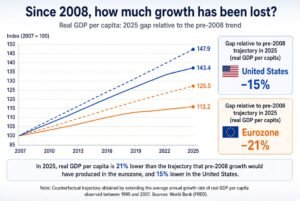
A creeping depression is not the absence of growth. It is the silent accumulation of growth that could have taken place but did not. A shortfall in potential wealth which, after almost twenty years, stands at -20 per cent for France and -21 per cent for the eurozone as a whole, compared with just -15 per cent in the United States. Overall, this is equivalent to around one-fifth of the real GDP of the Atlantic economies in 2025.
It is from this perspective that we must view the situation in France.
Politicians may congratulate themselves on a GDP that is not yet clearly negative (-0.1 per cent in the last quarter). But households do not live by quarterly fluctuations in GDP. Their reality is that of an economy where job prospects are dwindling, where income growth is perceived as insufficient, and where the future is becoming increasingly uncertain compared with what they had anticipated.
The trend in French household confidence provides a striking illustration of this. In October, the confidence index fell to 80, its lowest level since 2013. Even more telling is that the French people’s assessment of past changes in their standard of living reached its most negative point since surveys began in 1972.
This disconnect between the relative stability of macroeconomic aggregates and the deterioration in households’ economic sentiment should not be dismissed as a mere manifestation of collective pessimism. It reflects a cumulative experience of stagnation and dashed expectations.
The political crisis thus appears in a different light. Parliamentary clashes, social protests, urban riots and mistrust of institutions are not merely the causes of growing economic uncertainty. They are also the consequences of frustration that has built up over a much longer period than just Emmanuel Macron’s two five-year terms.
This shift in perspective is particularly significant when addressing the issue of public debt.
The French debate tends to present debt as an essentially national problem, the result of decades of fiscal irresponsibility. There is, of course, a degree of responsibility that stems from France’s own choices. But why do debt problems, persistent deficits and strains on public finances also feature among most of our Western partners – albeit with less urgency?
The answer lies in the widespread slowdown in growth observed since the 2008 crisis. An economy that is persistently unable to regain its productive dynamism sees its tax revenues grow more slowly than hoped, whilst public spending requirements remain as high as ever. Debt thus becomes, at the same time, both a tool used to compensate for insufficient growth and an additional cause of the slowdown.
Debt can therefore prolong stagnation whilst also being a consequence of it. This vicious circle does not absolve countries of their fiscal responsibilities, but it does require us to reframe the debate within the context of a much broader and more fundamental reflection on the origins of the major economic rupture that occurred twenty years ago.
It is this long-term perspective that is currently missing from the French debate.
As the elections approach, the controversies centre on immediate political responsibilities, deficit figures and day-to-day market reactions. Economists are rightly alarmed by the widening spread between French and German bond yields.
These questions are certainly legitimate. But the intensity of the debate prevents us from realising that, in the current international context, and over the entire period, France’s economic decline, whilst very real, is in fact nothing out of the ordinary, nor is it, all things considered, of any significant magnitude. More seriously, it distracts us from the real, unanswered question to which all the current discussions will never lead anywhere: how is it that, nearly twenty years on from 2008, much of Europe – and indeed the United States – has still not regained the conditions for sufficiently dynamic growth to restore prospects for sustainable prosperity?
The crisis in France is not merely a crisis of governance, of the budget deficit or of market confidence. It is not by dramatising every fluctuation in interest rates or every parliamentary episode that we will understand what is happening to us. Rather, it is by regaining the broader perspective on these twenty years of lost growth.
The author adds: “This article was supported by a personal AI (Chat GPT). The figures cited result from calculations carried out directly by this AI using strictly homogeneous statistical series from the World Bank, accessible via the Federal Reserve Bank of St Louis (FRED). They do not measure wealth whose production was guaranteed. But they reveal a lasting rupture – particularly profound in Europe – which the traditional focus on quarterly fluctuations in GDP tends to obscure. Hence the notion of a ‘creeping depression’: not an economy that is collapsing, but one that, year after year, is drifting ever further away from its former trajectory of prosperity.”
Originally published in French by Contrepoints