By Justin T. Callais, Chief Economist of Archbridge
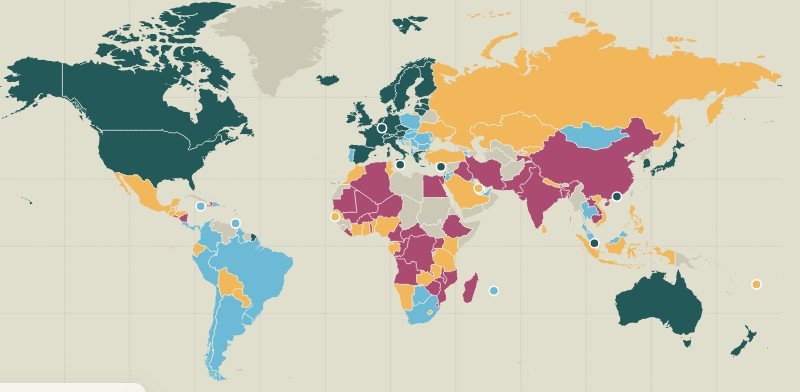
This week, the Archbridge Institute—a nonpartisan, independent public policy think tank—released its first-ever international social mobility index, the most comprehensive measure to date of the key barriers affecting upward mobility. Titled “Social Mobility Around the World,” the global analysis ranks 132 countries on three pillars: “Entrepreneurship and Growth”; “Institutions and Rule of Law”; and “Education and Civil Society.” Switzerland ranks first in 2026, followed by Denmark and Norway, while the United States lands at fourth and the United Kingdom slips to 20th overall.
Where the EU as a whole generally struggles is with labor regulation. Seventeen of the 27 member states rank in the bottom half of the world on labor-market regulation. Rigid rules—such as high dismissal costs and limits on fixed-term contracts—make every new hire a costly bet for employers and harm young workers disproportionately. Ireland stands out as a counter-example, ranking 11th globally for more flexible labor regulations. It has low dismissal costs and decentralized bargaining relative to the rest of the region.
Business regulation is also a mixed bag. While 10 EU countries score in the top 20 in the world for light business regulation, six fall outside the top 60, including Greece, Italy, and Bulgaria. Estonia’s path from a post-Soviet state shows that better policies can expand opportunities for citizens. It has the lowest business-regulation barriers in the EU (and third in the world), helped by a digital state that lets companies register and file online.
Where is opportunity most possible? At @ArchbridgeInst, we just released our new report, Social Mobility Around the World, which scores and ranks 132 countries on the conditions that let people climb the ladder. Co-authored w/ @cl7martinez pic.twitter.com/HMykPhzYb7
— Justin Callais (@JustinTCallais) November 9, 2026
Social mobility is at the core of human flourishing, and it is best advanced by reducing government barriers so that people can build better lives for themselves. If the EU wants more of its citizens to climb the economic ladder, two reforms stand out—each with a working model inside the EU.
The first is more flexible labor-market regulation. Ireland (11th globally and best in the EU) is the model: it keeps the cost of hiring and firing low, and wages are set firm by firm rather than by national agreements. The second is business regulation—covering compliance costs, licensing, and the ease of starting a business.
Here Estonia stands out (third globally and first in the EU) by putting the administrative state online. A company can be registered in hours, file nearly all tax returns electronically, and, under its “once-only” rule, the government may not ask a business for information it already holds.
Brussels could push member states to follow these examples in order to address Europe’s relative economic decline. Together, these low-cost reforms would lower two barriers that currently keep Europe’s young people and would-be entrepreneurs from flourishing on their own terms.
Disclaimer: www.BrusselsReport.eu will under no circumstance be held legally responsible or liable for the content of any article appearing on the website, as only the author of an article is legally responsible for that, also in accordance with the terms of use.