
By Dr. Nima Sanandaji, Director of European Centre for Entrepreneurship and Policy Reform (ECEPR).
For the past ten years, ECEPR has been mapping Europe’s knowledge-intensive jobs in a recurring study, with a particular focus on how the geography of knowledge is shifting. These studies with support from Nordic Capital — which have garnered widespread attention from governments, universities, the media, and business organizations — reveal a gradual trend in which countries and regions with lower taxes and a higher concentration of experts are growing the fastest. Brussels in particular and Belgium as a whole, however do not reach up to their potential.
Brussels is not only the capital of Belgium, and the EU, but also of Nato as well as an important seat for the UN. This world capital attracts many head offices, which explains why 29 500 in the Brussels region are employed in head offices & management. There are also some 19 000 employed in programming, 11 000 in engineering & architecture, and 1 950 in pharmaceuticals. In total there are 90 100 so called brain business jobs in the Brussels region, in twelve different categories of knowledge intensive jobs in technology, ICT, advanced services, and creative professions. This is however merely corresponding to 11.2 percent of the adult population of the region.
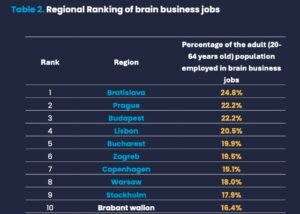
Out of 244 European regions, Brussels ranks only on 27th place in terms of brain business jobs density. As comparison, in Bratislava fully 24.8 percent of the adults are employed in brain business jobs, while the rate in Prague, Budapest, and Lisbon is also above 20 percent, in Bucharest just under. Zagreb and Copenhagen have above 19 percent of adults employed in highly knowledge intensive jobs, while the rate is just below 18 percent in Stockholm.
The Geography of Europes brain business jobs keep shifting to regions that combine talent supply, with attractive taxes and business climate. Grateful to work with this project, about the changing landscape of knowledge intensive jobs. pic.twitter.com/FcY1cUcPJu
— Nima Sanandaji (@NimaSanandaji) September 7, 2025
Interestingly, Brabant wallon in Belgium is the only top 10 region with highest share of adults in brain business jobs that is not a capital region. There 16.4 percent of adults are employed in highly knowledge intensive jobs. The Utrecht region in the Netherlands ranks just outside the top 10 list, with nearly same share of adults in knowledge intensive jobs as Brabant wallon. These two regions are unique, in that they are European non-capital regions which have a higher share of adults employed in brain business jobs compared to the capital regions of their respective countries. The pattern is otherwise that capital regions are far ahead.
Brabant wallon has a significantly stronger pharmaceutical sector than Brussels, with 12 200 jobs, and has a larger tech sector in general. In total Brabant wallon has 38 800 brain business jobs. While the total number is smaller, the rate of adults employed in highly knowledge intensive jobs is significantly ahead of Brussels. While the Brabant wallon region has less than 30 percent of the adult population of the Brussels region, it has nearly half as many brain business jobs.
The brain business jobs research shows that factors such as competitive taxes, having strong school education systems and presence of top 100 global engineering & mathematics universities, property rights protection, and business openness can influence success in boosting knowledge intensive jobs.
Brussels fails to live up to its potential since the city is too focused on bureaucratic control and too little on improving the conditions for new and expanding businesses. Brussels is one of the most important capital regions in all the world, yet far behind the leading European regions when it comes to knowledge intensive jobs. The region can learn from Brabant wallon, which leads in knowledge density without being one of the world´s leading capital regions.
On a country comparison, there are many smaller and medium sized European countries that used to be behind Belgium in economic development, but are outpacing it through lower taxes and more growth oriented business regulation. A significantly higher share of the population of Malta, Estonia, Cyprus and Slovenia are employed in brain business jobs compared to in Belgium. Also, Hungary, and Lithuania, have somewhat higher share of adults employed in highly knowledge intensive jobs compared to Belgium. The simple reason is that the high taxes of Belgium crowd out knowledge intensive jobs growth. Belgium in general and Brussels in particular have a lot of potential, but need a growth-oriented policy to grow as knowledge economies.
Disclaimer: www.BrusselsReport.eu will under no circumstance be held legally responsible or liable for the content of any article appearing on the website, as only the author of an article is legally responsible for that, also in accordance with the terms of use.