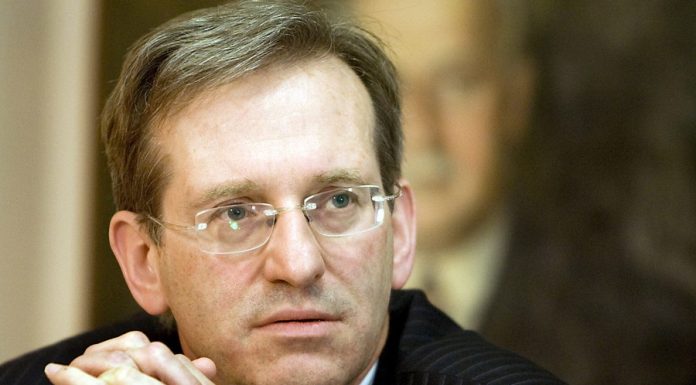
In an interview with Brussels Report, Matthew Robinson, Director of the Euro-Gulf Information Centre, comments the ongoing developments related to the war in Iran. The Euro-Gulf Information Centre is a think tank aiming to contribute to enhancing strategic, cultural, economic and political ties between Europe and the countries in the Gulf region.
Brussels Report: To what extent do you assess that Gulf states—particularly Saudi Arabia and the UAE—might shift from a predominantly defensive posture to a more offensive role vis-à-vis Iran, and what political or security thresholds would need to be crossed for such a transition to occur?’
Matthew Robinson: Ultimately, the GCC are the victims of unprovoked Iranian aggression. The priority of the Gulf countries correctly remains to take defensive, protective and burden-sharing posture. Their immediate mandate is to protect its citizens and residents, ports, desalination, aviation and energy infrastructure from Iranian actions, not open up a new front.
That being said, the threshold may change if Iran conducted massive casualties on the Gulf cities, attacked sensitive infrastructure for long periods of time, or was able to prove its capabilities to choke off the Strait of Hormuz for a prolonged period with no effective international response. In that scenario, some Gulf countries, could come to the conclusion that pure defence is no longer adequate and shift towards more direct involvement in coercive operations, whether military or through enhanced intelligence, logistical and base support.
The GCC is rightly angry and anxious about paying a price for a war they do not want.
'There was very little said that could offer reassurance to Gulf states.'
Sky correspondent @sallylockwood reacts live from Dubai to Donald Trump's televised statement on the Iran war.
Iran war latest: https://t.co/kCaC586qoK
📺 Sky 501 and YouTube pic.twitter.com/O50f0S7CkU
— Sky News (@SkyNews) April 2, 2026
Brussels Report: How would you evaluate the current level of damage to energy infrastructure in Iran and the wider Gulf region, and what are the short- to medium-term implications for global energy markets if the situation continues to escalate?
Matthew Robinson: The harm is already bad enough to push far beyond the pale of market nerves. There have been significant attacks right across the GCC, involving facilities and/or other infrastructure in Saudi Arabia, Kuwait, Qatar, Bahrain, Oman and the UAE – among the most significant Qatar’s Ras Laffan complex, Saudi refinery assets, UAE gas infrastructure and ongoing pressure on Fujairah. Earlier strikes in Qatar have decimated 17%, so far, of that country’s LNG production, QatarEnergy has said, and more widespread supply disruption via Hormuz has pushed both the crude and gas prices into deep uncertainty.
The short-term effect is continued price volatility, supply issues, rising insurance, freight costs. The medium-term effect, if it continues on, is a more expensive energy environment in Europe and Asia, with industrial, trade, transport and inflationary implications. The IEA has warned that in order to stabilise markets, transit through Strait of Hormuz must be restored.
Brussels Report: Do you anticipate a potential strategic divergence between the United States and Israel in their approach toward Iran, and if so, what factors or developments could drive a meaningful split in their policies?
Matthew Robinson: A meaningful separation could emerge, but one that is not absolute. The most likely source of divergence would have to do with end-state and timing, the White House might increasingly want to see a politically saleable wind-down if domestic pressure, oil prices and diplomatic tensions continue to rise while Israel might prefer pressing the military advantage for as long as possible to destroy all Iran’s defensive and offensive capabilities.
President Trump’s (1 April) speech encapsulated that uncertainty. He signalled that US war goals had been almost successfully reached, but also laid out potential future strikes within the next two to three weeks and possible attacks against Iranian oil and power infrastructure unless Iran complied. These points suggests tactical convergence but perhaps strategic friction in how much is ‘enough’, how soon to cease, and whether negotiations are credible.
PRESIDENT TRUMP: We have all the cards, Iran has none. We are in this military operation for 32 days and they have been eviscerated. They are no longer the bully of the Middle East.
This is a true investment in our children and grandchildren's future. pic.twitter.com/Bo45IsIJLT
— Department of State (@StateDept) April 2, 2026
Brussels Report: ‘What concrete policy options are realistically available to European countries in responding to this crisis, both in terms of de-escalation efforts and in safeguarding their own economic and security interests?’
Matthew Robinson: Europe has more options than it likes to acknowledge. For one it should urgently assist in ensuring freedom of navigation in and around the Strait of Hormuz with maritime protection, maritime surveillance, coordination in escorts and naval burden-sharing arrangements with willing participants.
Second, it must increase diplomatic pressure on Iran, asserting that attacks on civilian and energy infrastructure in the Gulf are not permissible and cannot be excused away.
Third it should double its efforts to ensure economic resilience instruments at home, including emergency stock coordination, fuel contingency planning, LNG diversification and targeted support for vulnerable industries. Europe, EU and non-EU, should be clear eyed.
The Strait of Hormuz crisis is far from a remote issue; it is a key artery for Europe’s energy security, trade flows and inflation outlook. In this regard, President Trump was right when he argued that countries dependent on Gulf oil and energy resources, should do more to safeguard the route.
Ships that want to transit through the Strait of Hormuz are being asked to pay fees in yuan to get a secret passcode https://t.co/4MXkicxxmK
— Bloomberg (@business) April 1, 2026
Brussels Report: In light of concerns about Iran’s potential ability to project force over long distances—including scenarios involving targets such as Diego Garcia—how should European policymakers reassess the level and nature of the threat posed by Iran to Europe’s broader security architecture?
Matthew Robinson: European policymakers must stop treating Iran as simply a regional irritant. The targeting of locations as far-away as Diego Garcia suggest that Iran’s challenge profile could be wider, more flexible and more ambitious than many in Europe originally thought. That may prompt a rethink not just of missile and drone risks, but also maritime coercion, proxy warfare, cyber disruption and strategic blackmail on trade and energy routes on which Europe relies.
The lesson for Europe should not be short-term panic, but long-term seriousness. Iran’s ability to threaten the broader security architecture surrounding Europe is real and the GCC frontline is inextricably linked to European and NATO security priorities. A regime willing to monstrously attacked Gulf countries, threaten shipping and hold global energy markets hostage is a strategic threat of the highest order, and must be dealt with seriousness it demands. Europe could not afford to remain passive. Safeguarding the Strait of Hormuz by all appropriate means, is no longer an optional act of diplomacy but should rather constitutes a fundamental objective of European economic and strategic self-interest.