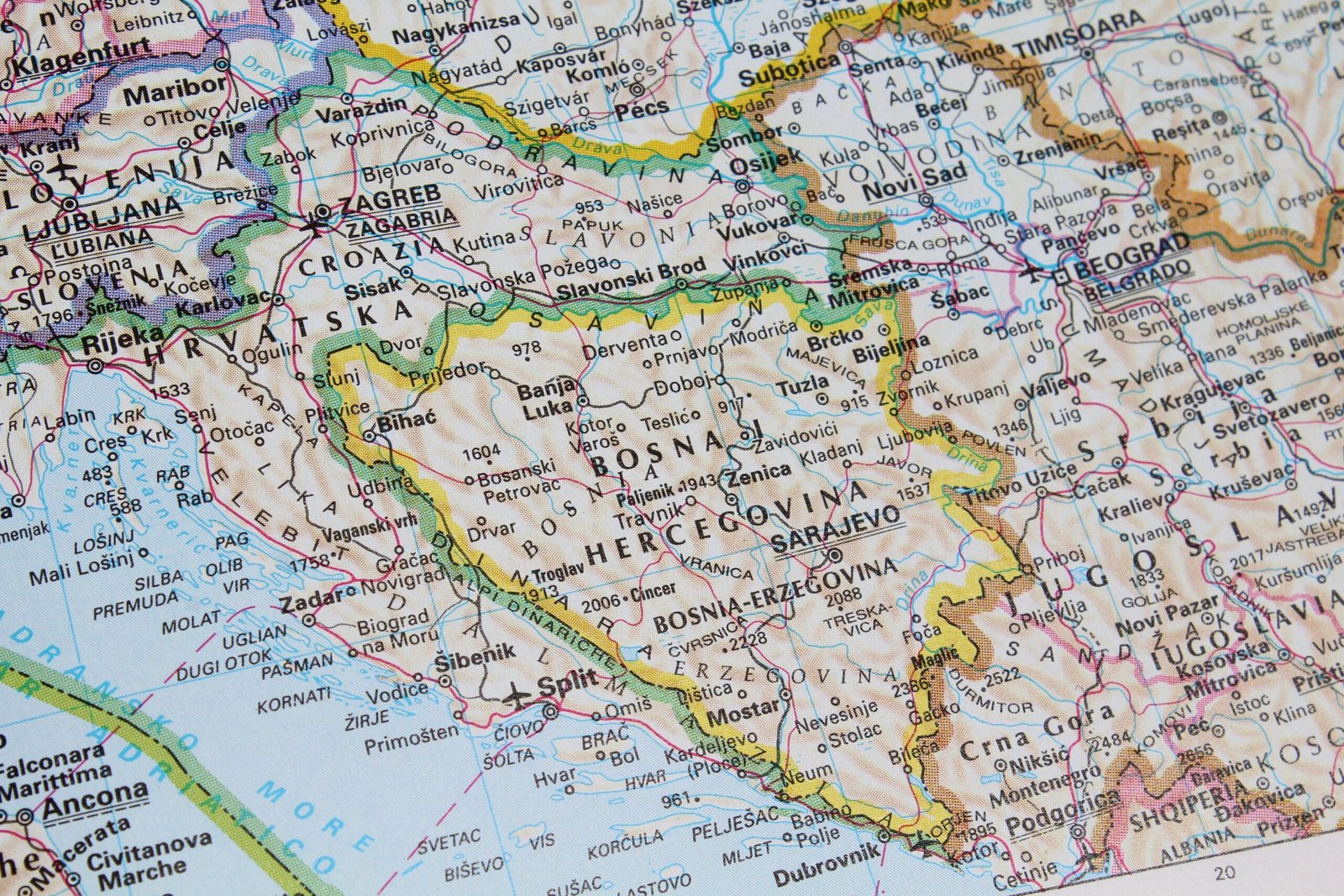
On 4 October, general elections are scheduled in Bosnia-Herzegovina, to decide the composition of the presidency as well as national, entity and cantonal governments. After the bloody war in the 1990s, a shaky political system was designed whereby the country is broadly split in two: one part is the Federation of Bosnia and Herzegovina (BiH), where mostly the Bosniak and Croatian part of the population lives, and the other is Republika Srpska, where the Serbian part lives.
The Bosniak-Croatian parts counts eight cantons, five of which are Bosniak-majority, three are Croat-majority and two are ethnically mixed. The Presidency of Bosnia and Herzegovina consists of three members: one Bosniak and one Croat, who are elected from BiH, and one Serb, who is elected from Republika Srpska.
In total, Bosnia-Herzegovina, a country of 2.5 million, counts 149 ministers in 13 governments, nine presidents and vice presidents, and 635 members of parliament. Clearly, this constitutes a high price for pacification, but whether one agrees with the current structures or not, it is evident that profound problems remain.
US Congressional Pressure
A first and timely issue concerns the position of the so-called “High Representative” for Bosnia and Herzegovina. This is an international official who is tasked to oversee the civilian parts of the peace deal that ended the 1992–1995 Bosnian War. In 1997, the official received extra powers, called the “Bonn powers”. This allows the High Representative to pass new laws, cancel existing laws, and fire elected or appointed local officials who break or block the peace agreement. The powers earned high representatives the nickname of “Viceroy of Bosnia.”
Until recently, Christian Schmidt, a former German Agriculture Minister, occupied the position. He stepped down in May 2026, apparently in part due to pressure from the United States, after a sharp confrontation with Milorad Dodik, the President of Republika Srpska at the time. Dodik had been indicted for passing legislation that defied decisions by the high representative. In 2023, Schmidt had amended the criminal code, introducing a measure whereby failing to carry out or obstructing his decisions became an official offence.
The topic has an international dimension, as recently, US Member of Congress Celeste Maloy pressed the US Treasury Department in a letter to investigate allegations that Schmidt and members of the Central Election Commission of Bosnia and Herzegovina interfered with the democratic process in Republika Srpska, in the context of the removal of Dodik.
International tensions
Dodik’s presidential mandate had been revoked in August 2025 following a court verdict sentencing him to one year in prison and a six-year ban on holding presidential office. In April 2025, Schmidt had also suspended the disbursement of public funds for Dodik’s political party. In protest, Dodik cited the lack of Schmidt’s authorisation by the UN Security Council, also stating: “How is it that other parties will receive those funds and we won’t?”
Earlier sanctions imposed by the U.S. on Dodik were lifted by U.S. President Donald Trump in the Summer of 2025. There are ongoing tensions about the issue within the Western alliance. Italy’s proposal to nominate one of its diplomats, Antonio Zanardi Landi, for the position of High Representative is being supported by the United States. However, France, the UK and Germany support a French diplomat, René Troccaz. The U.S. thereby apparently prefers a High Representative who intervenes less deeply in Bosnia’s internal governance and who exercises his exceptional powers more cautiously. European governments are more wary about a rapid scaling back of international oversight.
The 2022 crisis
The whole episode followed an earlier bombshell during the previous general elections, on October 2022. Then, right after the voting booths were closed, Schmidt imposed changes to the Election Law of BiH as well as 21 amendments to the Constitution of the Federation of BiH.
Writing for Verfassungsblog.de, Constitutional law Professors Jens Woelk and Maja Sahadžić comment on this, noting:
“This caused widespread anxiety in parts of the country and demonstrations in front of the Office of the High Representative building in Sarajevo. Dark premonitions were soon dispelled when the High Representative seemingly changed his mind and imposed only technical changes to the Election Law. Visibly under pressure, the High Representative even had an outburst in front of cameras but maintained that he may impose further changes as well.”
They thereby quote a 2005 opinion from the Venice Commission on the constitutional situation in BiH, which stated:
“…it is however certainly not a normal situation that an unelected foreigner exercises such powers in a Council of Europe member state and the justification for these powers for the future merits not only political but also legal consideration. The powers can be qualified as emergency powers. By their very nature, emergency powers have however to cease together with the emergency originally justifying their use.”
Some have claimed that Schmidt’s changes benefited Bosnian Croats electorally. Perhaps his institutional changes can be defended, given the situation of the Croats. In the 2016 Ljubić case, the Constitutional Court of the Bosniak – Croat Federation has ruled that the election laws violate the Dayton Peace Agreement, as they allow the numerically dominant Bosniaks in the Federation entity to outvote the Croat minority. Thereby, they are effectively able to choose the Croat member of the tripartite presidency as well as delegates to the Parliament.
As much this may be a valid concern, to see important institutional changes being imposed while votes are being counted is not exactly a good look.
Lingering institutional questions
Last but not least, there is the ethnic nature of Bosnia-Herzegovina’s constitutional structure. The European Court of Human Rights ruled in 2009 that this constitutional structure was discriminatory in the case of Sejdić and Finci v. Bosnia and Herzegovina.
In this case, Dervo Sejdić, of Roma origin, and Jakob Finci, a Jewish Bosnian citizen, were unable to stand as candidates for the Presidency and the House of Peoples because they did not belong to one of the three constitutionally recognised constituent peoples.
Part of the problem here is that the 1995 Dayton Agreement was primarily meant to secure peace and less to provide a long-term institutional arrangement going forward. Due to the lingering tensions, it has proven politically impossible to agree any institutional alternative.
A way forward
The European Parliament, German think tank European Stability Initiative and many others have called for profound changes to the country’s institutional architecture, but as professor of constitutional law Nedim Ademović explained to Euronews, abolishing the entire system would strip away the specific protections the leaders of Bosnia’s ethnic parties have had for decades — and with them, their power and wealth. About the judicial rulings that challenge the many cases of discrimination in the institutional system, he notes:
“None of the ethnonationalist parties are interested in the implementation of those rulings because that would mean that ethnonationalism would have to be abolished.”
In a seminal paper on the topic, the Heritage Foundation’s Max Primorac suggests an alternative way forward. He writes:
“The goal of strengthening central government institutions at the expense of ethnicity-based subnational ones is the core of BiH’s crisis. A civic state that replaces ethnicity as the governing framework aligns with the majority Muslims’ political goal of establishing a centralized unitary state. “One man, one vote” would lead to a majoritarian government in a country lacking democratic norms.
(…) Instead of following the examples of Belgium, Switzerland, and other successful consociational models of governance that rely on the equality of constituent peoples to manage tensions, the Office of the High Representative, with U.S. State Department connivance, has been pushing an unpopular common Bosnian identity through fiat while punishing opponents for legitimate nationalist expressions.”
Instead, he suggests “establishing three units from its two dysfunctional entities, one each for Muslim Bosniaks, Catholic Croats, and Orthodox Serbs, within a confederal system, like that successfully practiced in Belgium and Switzerland. It would not require territorial exchanges as each federal unit would reflect areas already controlled by Bosniaks, Croats, and Serbs for the past 30 years.
Republika Srpska’s territory was delineated at Dayton in 1995, while the Bosniak–Croat federation is de facto divided into two parts as reflected by its separate and communally based utility companies (power, telecommunications, and postal networks). In other words, there are no territorial disputes to resolve, and the three federal entities would reflect the practical reality on the ground and give each community a governing stake in making BiH work.”
In any case, Belgium and Switzerland have often been cited as a possible institutional template for a country with deep ethnic divisions for good reason. Simple solutions certainly do not exist for Bosnia-Herzegovina, but if something does not work, it may be time to look for alternatives.