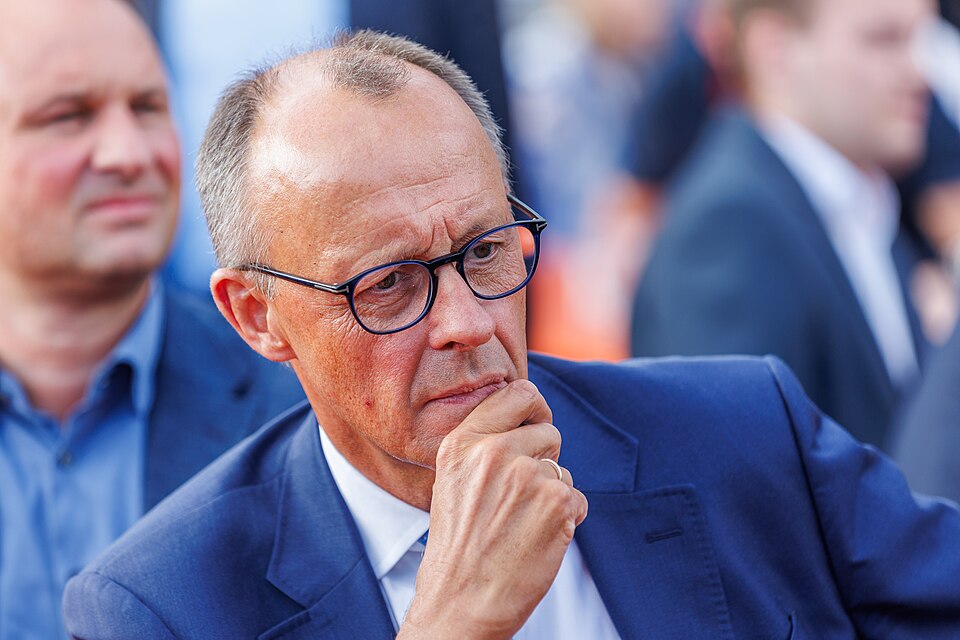
Following the victory of Germany’s right-wing populist Alternative for Germany (AfD) in the eastern state of Saxony-Anhalt, German Chancellor Friedrich Merz stated during a heated parliamentary debate: “If those working in Germany have to leave the country again because you are championing ‘remigration’ (…) then the skilled trades in Germany will no longer be able to function: not a single care home will remain open, not a single hospital in Germany will remain operational, and not a single restaurant in Germany will be able to stay in business.”
In the past, Merz himself has stated “the boat is full”, when discussing migration. AfD co-leader Alice Weidel reacted that Merz’s CDU party had been “pulverised”, as she called the elections a referendum on Merz’s leadership. She added:“Your time is up. The public want a change in policy, and they will get it,” reiterating her party’s aim to form a federal government in the foreseeable future.
It shows how immigration is back from never been away as the leading political topic in Germany. The topic has always been the main driver of support for the AfD, which has been boosted by chaotic inflows into Germany since at least 2015, when former Chancellor Angela Merkel decided to stop returning Syrian asylum seekers to their first port of entry in the EU. Combined with a lack of proper vetting for people entering the country, a series of terrorist attacks and serious integration challenges followed. Merz promised to be tough on immigration, but in practice, “Merz has failed to deliver on any of his boldly proclaimed goals,” according to Andreas Busch, a professor at the University of Göttingen.
Courts have, for example, overruled his policy of turning people away at the border. Surely, German legal restrictions play a role, but at the heart of this, are all kinds of legal registrations introduced by both the European Union’s legal framework and the European Convention for Human Rights.
To be precise, the interpretation by judges of these Treaty arrangements is up for debate, to put it mildly. A Dutch judge recently ruled that returning a Russian national to Italy would constitute a breach of Article 3 of the European Convention on Human Rights, namely the prohibition of torture. According to the judge, the Dutch government had failed to demonstrate sufficiently that Italy could be trusted in this regard.
Such a ruling undermines the new European Migration Pact, which is intended to facilitate such transfers. That new pact had already been cited by many centrist European politicians as an important step towards a better border policy.
Professor Marc Bossuyt, the former President of the Belgian Constitutional Court and former Belgian Commissioner General for Refugees, has been one of Europe’s most prominent critics of the Human Rights court in Strasbourg for years. In an interview last year, he commented: “the combination of the M.S.S. ruling in 2011, which undermined the European Dublin Regulation, and the Hirsi Jamaa ruling in 2012, which opened the floodgates to migrants trying to reach Europe by sea, led to the asylum chaos of 2015. In my opinion, these rulings contributed even more to this than the Syrian civil war and Angela Merkel’s subsequent ‘Wir schaffen das’ policy.”
Economic worries
Apart from immigration, another important factor for AfD’s success is the state of the German economy. In Saxony-Anhalt there has long been frustration over the economic gap with western Germany, but in recent years the country as a whole has struggled to escape recession. The announcement of 100,000 job cuts at Volkswagen only underlines the point.
At the heart of this is Germany’s experimental energy policy, the phase-out of coal and nuclear power, amplified by the loss of cheap Russian energy. On top of that, high taxes and rigid regulation have been eroding competitiveness for years. Germany can do a lot when it comes to energy policy, but apart from German regulatory changes, also EU climate policies will need to be abandoned. The very first on the chopping block should be the EU’s destructive Emission Trading System (ETS), a de facto climate taxation scheme which makes energy incredibly expensive and European industry uncompetitive.
In response to the election victory, AfD co-leader Alice Weidel even stated: “Germany is de facto bankrupt. Germany is broke, and they are not telling you that.”
Given a debt-to-GDP ratio of about 63.5 percent and a triple-A rating, she is clearly exaggerating. Still, at least since the Covid crisis, Germany has experienced lacklustre growth and falling industrial production. If that continues, fiscal strains may follow, not least because the Merz government has also loosened the constitutional debt brake to allow more spending on defence and infrastructure.
Hope
There are, however, some signs of hope. Earlier this month, the ifo Institute raised its forecast for German economic growth this year by 0.6 percentage points, estimating that the economy would expand by 1.4 percent. “The recovery of the German economy is continuing,” Timo Wollmershäuser, ifo’s head of economic forecasts, said.
This week, the announcement that the United Arab Emirates (UAE) are about to make major investments in Germany signifies another hopeful development. As the state visit to Germany of UAE President Sheikh Mohamed bin Zayed Al Nahyan kicked off, UAE Minister of State Lana Nusseibeh explained : “Over the course of this visit, the UAE and Germany will announce a number of key announcements and multi-billion-Euro agreements across investment, business, technology, AI, and energy – strategic sectors that not only underpin our shared economic ambitions, but also make a tangible difference to the livelihoods and prosperity of our peoples.”
The deepening cooperation follows significant investments by the UAE in Italy and France, which demonstrates that the UAE stay consistent in their commitment to investing in Europe, despite the regional tensions. Notably, it is accompanied with diplomatic and security cooperation.
Sustainable green shoots?
Despite the green shoots, the road is still long. New industrial-production figures for July suggest the German recovery may already be stalling. That underlines the need for profound political change. Unlike Belgium, which announced a nuclear phase-out but later reversed it, the German government still insists on ending nuclear power.
The same applies to fossil fuels. Even from the most environmentally radical point of view, it makes little sense to phase out domestic production only to import expensive fossil fuels from abroad. US LNG is a case in point: it helps support the German economy, but at a high price. Much of that gas comes from fracking, which is banned in Germany. Back in 2022, Bavarian Prime Minister Markus Söder suggested Germany should examine fracking to extract domestic natural gas amid the energy crisis exacerbated by Russia’s war against Ukraine. He said: “We have to examine what is possible and reasonable with an open mind.” He also noted that the United States had made itself “completely independent of the Middle East” thanks to fracking.
Similar arguments are often made about the need to streamline regulation and make the tax environment more competitive.
On immigration, too, little of substance has changed. EU-level efforts to tighten policy receive only lukewarm support from Germany, which wastes time on largely pointless spot checks at the Dutch border. Mere signalling.
For Germany’s political class, the AfD’s success should be a wake-up call: it is time to stop talking and start acting. But even if the mood finally changes in Berlin, this will not be enough. Also at the European level, fundamental changes to the legal framework for both energy policy and migration policy are needed.