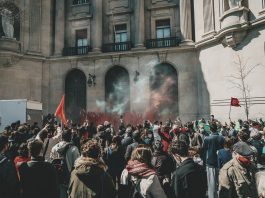
Greenpeace, one of the most well-known NGOs in the world, may be on the verge of bankruptcy, following a loss in a US Court case. Last month, a North Dakota judge ordered the NGO to pay 345 million dollars to Energy Transfer, the American company that built the Dakota Access Pipeline. The NGO was found guilty of defamation, sabotage, trespassing and deliberately interfering with the business operations of the company.
The judgment was in line with a decision issued in October, when the judge cut by nearly half a 667 million dollar damages award that a jury had awarded Energy Transfer in 2025. At the time, Greenpeace warned: “If the ruling is upheld, we will be forced to go bankrupt.”
In response, Greenpeace has now vowed it will seek a new trial and, if necessary, appeal the decision with the North Dakota Supreme Court. Notably however, the NGO has also sued the energy company in the Netherlands. The next hearing in the Court of Amsterdam is scheduled for 16 April, 2026.
In a commentary, Michael McKenna, a columnist for The Washington Times, questions the move, warning that if Greenpeace gets its way in the Netherlands, this would effectively amount to “European courts to nullify verdicts of American juries and American judges”. He adds:
“Energy Transfer’s case against Greenpeace has already provided a stark reminder of the lengths to which some are willing to go. In that trial, the jury heard compelling evidence that Greenpeace dispatched professional protesters to the region, provided equipment and then helped train other protesters at the site. Greenpeace also paid for lockboxes that protesters could use to tie themselves to construction equipment.
In the months that followed, protesters engaged in acts of violence, vandalism and arson in their efforts to prevent the pipeline from being constructed. Greenpeace also disseminated — let’s be charitable and call it inaccurate — information about the company and its project, wrongly claiming that the pipeline would cross the sacred tribal lands of the Standing Rock Sioux Tribe. (…)
In its European lawsuit, Greenpeace does not offer any new evidence to dispute the findings of the North Dakota jury, which spent weeks hearing expert testimony and studying the evidence. Instead, it’s seeking a judiciary that is likely to have a more favourable view toward its brand of environmental extremism.”
Furthermore, in its Dutch lawsuit, Greenpeace is alleging that Energy Transfer’s lawsuit would be a so-called SLAPP (“Strategic Lawsuit Against Public Participation”) case, which is generally understood as a meritless or exaggerated lawsuit intended to intimidate, silence, or censor critics by burdening them with high legal costs. The NGO is trying to use new EU legislation targeting such lawsuits.
The American company is obviously denying that it would aim to intimate or censor Greenpeace, and also Washington Times columnist McKenna challenges the idea that the lawsuit would constitute a “SLAPP case”. He points out that “laws against strategic lawsuits against public participation were originally developed to protect free speech by shutting down frivolous lawsuits designed to silence people. In this case, the lawsuit was plainly not frivolous, given that a jury agreed with the plaintiff. Greenpeace’s ability to say what it thinks has not been impinged upon in any way. Indeed, it continues to regularly attack Energy Transfer in its press releases and blog posts.”
High stakes
The stakes are high. Writing in a commentary for Bloomberg Law, US lawyer Charles B. Meyer, stresses that “the resulting uncertainty” due to success for Greenpeace in the Netherlands “would send a chilling message to US companies operating in Europe and threaten the stability of major trade agreements—most notably the $750 billion US–EU energy pact through which Europe has committed to importing American liquefied natural gas. That deal is more than economic—it’s a strategic realignment designed to reduce Europe’s reliance on Russian energy and strengthen transatlantic ties.”
In a reference to the Netherlands, he thereby adds: “Ulrich Huber, a 17th-century Dutch jurist, developed the concept of comitas gentium—the civility of nations—as the foundation of private international law. Huber argued that foreign judgments should be honoured unless doing so would undermine state sovereignty or citizens’ rights. Nothing about the North Dakota verdict meets that exception.”
In Europe, public financing of NGOs may be at risk, but they remain active in courts. Last October, the Financial Times carried the headline that “Europe has become a risky place for corporate green claims”, after a Paris court found Total guilty of “misleading commercial practices” in its public claims to be a “major actor in the energy transition”. Also this court case was brought by several non-profit groups.
The newspaper noted that “the verdict is particularly striking because TotalEnergies has been investing much more heavily in green areas than most of its oil and gas peers, with $4.8bn of capital expenditure on low-carbon energy last year.” According to the FT, “the case is an important reflection of the tightening legal constraints in the EU around green claims by companies, following recent greenwashing verdicts against airlines KLM and Lufthansa.” It thereby adds that the “verdict made repeated reference to EU legislation passed last year, which prohibited green claims unsupported by “clear, objective, publicly available and verifiable commitments and targets”.
The European Commission wanted to go further still with its so-called green claims directive, which would have forced companies to submit sustainability related messaging for approval before it could be published to consumers. In what some may see as a sign of the times, that idea was withdrawn last June, amid concerns of bureaucratic over-reach and an excessive burden on businesses.”
EU support for NGOs
Meanwhile, the debate on the role of NGOs in European politics continues. Recently, Dutch MEP Dirk Gotink (EPP) highlighted that the European Commission is financing NGOs that are actively involved in legal proceedings against EU Member States. Last year, Gotink was one of the more prominent voices in the European Parliament pushing for greater transparency in the public funding of NGOs.
The new revelations follow what happened in the wake of a 2025 report by the European Court of Auditors, the EU’s institution’s own financial watchdog. This disclosed that European NGO’s have received €7 billion in EU support from 2021 to 2023, whereby the Court of Auditors criticized the funding for lacking both transparency and accountability.
Of particular concern was that the NGOs would in some cases be mere extensions of public institutions. Laima Andrikienė, the Lithuanian member of the Court of Auditors, revealed that “shocking” cases included “one large research institute” which was classified as an NGO even though it was “composed solely of government representatives.”
State funding for NGOs is under fire in Europe, not just at the EU level. The German government just decided a funding freeze for NGOs, with Karin Prien, Germany’s federal minister of Education, Family, Senior Citizens, Women and Youth explaining this by saying: “I don’t see diversity as a government funding objective.” More than 200 projects will no longer be funded by the government.