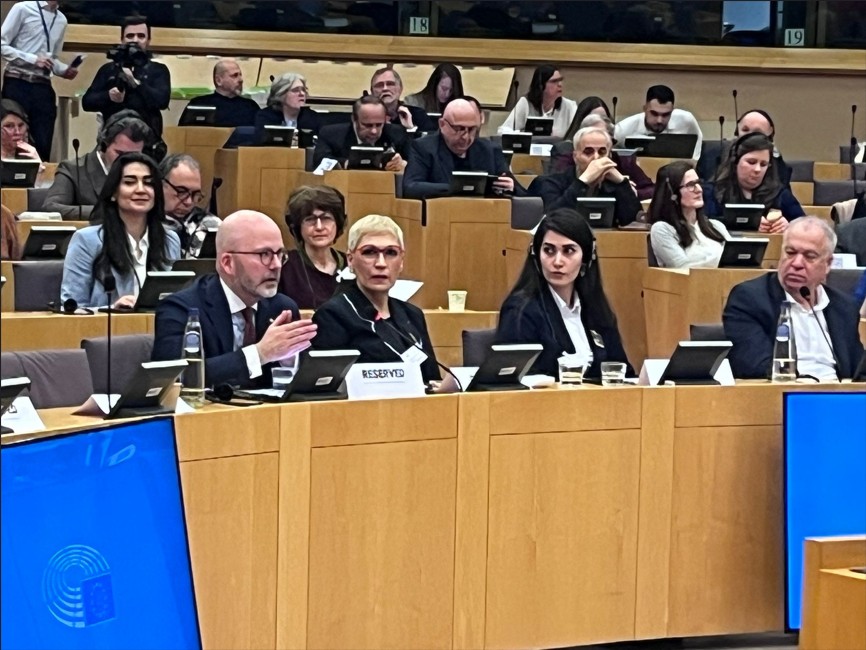
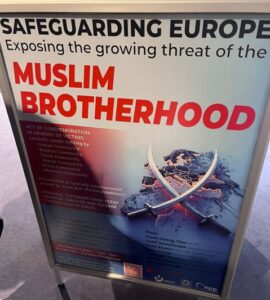
Brussels — Policymakers, researchers and representatives of several religious and ethnic communities gathered in the European Parliament on 4 March for a conference titled “Safeguarding Europe – Exposing the Growing Threat of the Muslim Brotherhood.” The event addressed the ideological, political and security implications of networks associated with the Muslim Brotherhood and broader forms of transnational political Islam.
The conference was hosted by Bert-Jan Ruissen, Member of the European Parliament, with Dr Tomáš Zdechovský MEP serving as co-host. The event was moderated by Patricia Teitelbaum.
Organisers said the aim of the gathering was to bring together policymakers, academic experts and representatives of different communities to examine the impact of Islamist ideological movements on European societies, democratic institutions and international security.
Thank you @IMPACoexistence: Patricia Teitelbaum and Nigel Goodrich for organising and moderating this event. Excellent work! Programme and references can be found here: https://t.co/qzVtlMi9k6
Thank you @TomasZdechovsky for hosting this event with us. https://t.co/VsVORALI8X
— Bert-Jan Ruissen (SGP EP) (@hjaruissen) March 4, 2026
The event opened with remarks from the hosting Members of the European Parliament, who emphasised the importance of addressing ideological extremism while safeguarding democratic freedoms.
Following the opening remarks, a symbolic commemoration ceremony honoured victims of extremist violence. Representatives of communities that have suffered persecution or violence from extremist movements participated in the segment.
Fahimeh Ilghami Dehkharghani, representing the Iranian community, lit a candle in remembrance of victims of political repression.
“I light this candle so we do not forget 90,000 lives taken from their families,” she said. “These victims are not just numbers. They are sons and daughters, fathers and mothers, neighbors and friends who died for dignity, freedom and justice. Their courage is a light that no one can ever extinguish.”
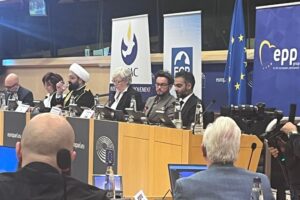
Representatives of Kurdish, Druze, Jewish and Christian communities also reflected on the experiences of their communities in regions affected by extremist movements.
The conference then moved to expert presentations addressing ideological structures and networks linked to political Islam.
Dr Tommaso Virgili, Senior Policy Advisor at the AJC Transatlantic Institute, discussed how ideological messaging can be strategically adapted to resonate with different audiences.
“As per the blueprint of ideologues such as Al-Qaradawi and Al-Mawdudi, Islamization is a matter of tactic, and tactic is often a matter of style,” Virgili said. “If you say that ‘the hijab is a religious obligation which the husband should enforce on the wife,’ quoting the European Council for Fatwa and Research, you might not come across very well in feminist circles. But if you say that ‘the hijab is a symbol of women’s agency through which they fight intersectional discrimination,’ you may find feminists marching on your side.”
He also noted how language can shape political responses.
“If you say that someone who offends Allah must be killed or imprisoned, you could be expelled or go to prison yourself. But if you say that a racist, fascist promoter of Islamophobia should be sent to prison, you might gain support from liberal lawmakers and even secure public funding.”
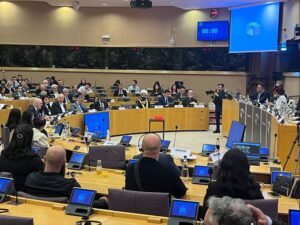
French researcher Dr Florence Bergeaud-Blackler of CNRS presented analysis on ideological networks associated with the Muslim Brotherhood and their influence in Europe.
Dr Charles Asher Small, founding executive director of the Institute for the Study of Global Antisemitism and Policy (ISGAP), addressed the conference via video link, discussing the relationship between antisemitism and ideological narratives circulating within certain Islamist networks.
Imam Mohammad Tawhidi, a Muslim theologian and member of the Global Imams Council, spoke about the need to distinguish between Islam as a religion and extremist ideological interpretations.
The event also featured a panel discussion with representatives of communities affected by extremism.
Rama Aboras, representing the Druze community, drew attention to the humanitarian crisis affecting Druze civilians in southern Syria.
“Since the attacks that took place last July, more than 2,500 people have been killed and residents of over 43 villages in western Suwayda have been forced to flee their homes,” she said. “The city continues to face severe shortages of humanitarian aid, electricity and water.”
She called on European countries to move beyond expressions of concern.
“Today the Druze community is calling on European countries to move from statements of concern to concrete action, including ensuring humanitarian aid reaches Suwayda under international supervision, protecting civilians and facilitating humanitarian visas for those at risk.”
Sadaf Daneshizadeh, representing Iranian civil society, addressed the broader ideological structure of the Islamic Republic.
“For forty-seven years Iran has not simply had a government but an ideology casting its shadow,” she said. “An ideology that replaced the will of the people with absolute obedience and legitimized repression.”
She argued that the system had built a security structure around ideology and highlighted the role of the Islamic Revolutionary Guard Corps.
“At the heart of this system stands the IRGC — not merely a military force but the ideological backbone of the Islamic Republic,” she said, adding that the relationship between the IRGC and movements such as the Muslim Brotherhood reflects what she described as a broader project of transnational political Islam.
Daneshizadeh also stressed that the Iranian protest movement represents a turning point.
“The ‘Woman, Life, Freedom’ movement was not a temporary protest,” she said. “It was the breaking of the wall of fear — a declaration that human dignity is non-negotiable.”
The panel was moderated by Ernest Herzog of the World Jewish Congress and included representatives of Kurdish, Druze, Christian and Iranian communities.
During the event, participants also presented a symbolic artwork by Israeli artist Yaron Bob, known for his “Rockets into Roses” project, which transforms fragments of rockets into sculptures shaped like roses — representing the transformation of violence into resilience and hope.
Organisers described the conference as part of a broader effort to stimulate debate among policymakers and civil society about ideological extremism and the political implications of transnational Islamist movements.
Disclaimer: www.BrusselsReport.eu will under no circumstance be held legally responsible or liable for the content of any article appearing on the website, as only the author of an article is legally responsible for that, also in accordance with the terms of use.