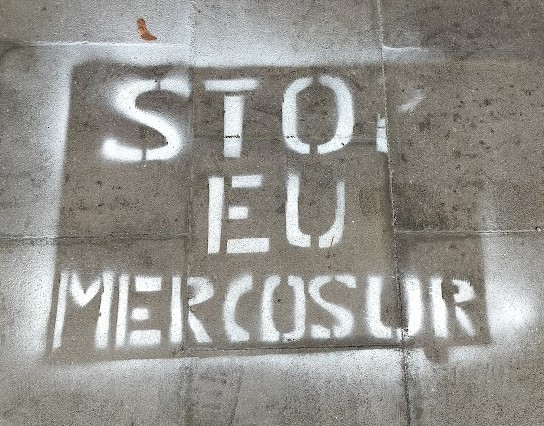
Suddenly, it does not appear so certain any more that the trade deal between the EU and Latin American trade bloc Mercosur – comprising Argentina, Brazil, Paraguay and Uruguay – will be ratified. The European Parliament is demanding stricter protective measures in the trade deal, following the fierce opposition by a number of member states. Giving in too much to these demands however risks having to reopen talks with Mercosur, which is not exactly a rosy prospect, as these have now been running for 25 years.
If the European Parliament does not approve the deal on 16 December, European Commission President Ursula von der Leyen won’t be able to fly to Brazil on 20 December, as planned, for a signing ceremony.
In November, EU member states already supported an arrangement implementing safeguards for agricultural products, but opponents like France still appear likely to vote against, following a unanimous vote by its national Parliament against the Mercosur deal. The decision in the EU Council will be made by qualified majority voting.
Separately, French President Emmanuel Macron is threatening China with higher tariffs, unless it takes action to reduce the country’s ever-widening trade deficit with the European Union. During his visit to China earlier this month, he urged the Chinese leadership to boost cooperation on “unsustainable” global trade imbalances, geopolitics and the environment. Afterwards, Macron said:
“I tried to explain to the Chinese that their trade surplus is unsustainable because they are killing their own customers, particularly by no longer importing much from us. (…) I told them that if they do not react, we Europeans would be forced, in the coming months, to take strong measures following the example of the United States, such as imposing tariffs on Chinese products.”
Euro politicians going to China should show this chart to their counterparts and ask if they think these scissors are politically sustainable or whether the US is a leading indicator for the future of EU-China trade, in which case who will provide the external demand China needs. https://t.co/qIx1sjNfCv pic.twitter.com/T5Tgc4Fjeo
— Daniel Kral (@DanielKral1) November 24, 2025
China's $1 trillion goods trade surplus is making the headlines today. But China is a large commodity importer (why other BRICs don't complain as much), its surplus in manufactured goods already surpassed $2 trillion this year, close to 2% of world GDP. A backlash was inevitable. https://t.co/mVSouI7IO7 pic.twitter.com/0xMnlv5VsN
— Daniel Kral (@DanielKral1) December 8, 2025
Responding to the Chinese challenge
It all shows that the forces of protectionism are very much still alive in Europe, despite the change of heart in EU circles in favour of free trade, following US President Donald Trump’s tariff policy.
Another example of this is how the European Commission has just published its proposal for 70% of critical goods content to be ‘made in Europe’. These provisions to mandate public bodies to buy European however provoked some backlash. Bruno Jacquemin, of French industry group the Alliance for Minerals, Metals and Materials commented: “I am doubtful about the practical effectiveness of a system run from Brussels”, adding: “Should Europe spell out everything it does for these national defence issues? I am not sure it is a good idea to proclaim that loudly.”
The fact that China is dominant in refining more than 90 percent of the world’s rare earths is obviously a justified concern, especially when it comes to defence-related products. China threatened new rare earth export limits in October, following earlier restrictions in April, providing new impetus to this debate. Then, more bureaucratic control over supply chains may well backfire in the end.
Furthermore, a number of EU member states are now also pushing backing against the “Buy European” proposal. A coalition led by the Czech Republic. also including Estonia, Finland, Ireland, Latvia, Malta, Portugal, Slovakia and Sweden, is concerned that the EU will end up harming itself if it seals off some sectors of the economy from the rest of the world.
Politico notes that a Czech position paper, signed by the other states, urges the European Commission to “exercise the highest possible caution when devising the ‘European preference’ approach,” as it adds: “Adopting disproportionate rules on ‘European preference’ as a standard in our policies could risk … a deepening of mistrust in the multilateral trading system and in the EU as a reliable and predictable partner.”
“I am doubtful about the practical effectiveness of a system run from Brussels," Jacquemim told RFI. "Should Europe spell out everything it does for these national defence issues? I am not sure it is a good idea to proclaim that loudly.” https://t.co/eblyCq60Nn
— Pieter Cleppe (@pietercleppe) December 5, 2025
Nobody is talking about “decoupling” from China any more, as the focus is now on “derisking” instead. Part of that is to diversify trade, so if it wants to do that, the EU should however not torpedo a hard-fought trade deal with a friendly jurisdiction, such as Mercosur.
Double standards towards trading partners
Also the EU’s trade relationship with the upcoming economic powerhouses of South East Asia have worsened in recent years, mostly as a result of the EU’s green regulatory avalanche, which also included imposing ever more bureaucracy onto companies importing and exporting.
Things appear to be changing, thankfully, now that the EU is watering down corporate sustainability rules and reducing its reporting duties and other bureaucratic requirements for companies. The “simplification” of the directives on corporate sustainability reporting (CSRD) and corporate sustainability due diligence (CS3D) is at least a first step in the right direction.
Also the new EU deforestation rules have been undermining good trade ties with the rest of the world, South East Asia not in the least. This new EU regulation requires exporters of cocoa, coffee, soy, palm oil, beef, and related products to demonstrate that the land used in production has not been subject to deforestation since the end of 2020. It badly soured the relationship between the EU and South-East Asian trading partners like Malaysia and Indonesia.
EU member states have now agreed to extend the regulation once again, this time until the end of December 2026, instead of allowing it to enter into force at the end of December of this year. A review clause, focusing on simplification, to be carried out by April 2026, is also foreseen. This decision by member states, later also approved by the European Parliament overrides the European Commission, which had proposed to only delay implementation for micro and small businesses, whereby large and medium businesses would merely a six-month grace period.
The official reason for the delay provided by the European Commission was that the IT systems managing EUDR compliance, but few believed that was the real reason. Many European businesses were dismayed over it, and the fact that EUDR had truly upset trade relations between the EU and its most important trading partners was also key.
FLA: The EUDR delay shows the rule is unworkable, infringes on private property rights, and creates unnecessary barriers for U.S. forest landowners. pic.twitter.com/J1DqeF8uKt
— Forest Landowners Association (@ForestLandowner) November 26, 2025
Scott: The EU is telling the American farmer that if their timber is cut and they are going to use that land for pastureland or production agriculture, they will not take the timber or the byproducts of the sale of that timber.
Trump: You give me a couple of paragraphs, don't… pic.twitter.com/7PuITkHlsh
— Acyn (@Acyn) December 8, 2025
After US President Trump managed to secure a partial exemption for American products, countries like Indonesia and Malaysia, which are great exporters of palm oil, asked for the same. Malaysia thereby considers it particularly unfair that its imports are classified by the EU as ‘standard risk’, as opposed to the American classification of ‘low risk’, given that Malaysian deforestation has improved significantly, with NGOs acknowledging a reduction of 13 per cent last year. Malaysia lost just 0.56% of its remaining primary forest in 2024, according to Global Forest Watch. That is less than Sweden’s 0.87% loss.
The EU’s double standards in trade are also visible with the European protectionist climate tariff “Carbon Border Adjustment Mechanism” (CBAM), which imposes levies on trading partners that do not follow the EU’s suicidal climate policy, as well as a lot of bureaucracy, even for European companies. Incredibly, it still is not clear how this system will work, even if it is supposed to enter into force on the 1st of January.
Also here, the U.S. secure concessions, which led to a demand by South Africa to also be exempted, given the cost to African economies as a result of CBAM. Just like with the EU’s deforestation rules, attempts to impose rules on trading partners are causing discontent, double standards and a lack of progress in opening up trade between the EU and the rest of the world. None of this is not the EU in its quest for “derisking” from China.
EU overreach on tech regulation
The U.S. wants the EU go further when it comes to watering down green policies. The US Ambassador to the EU, Andrew Puzder, has just reiterated US’ opposition to “ESG” rules like the CS3D, warning that these could hinder Europe’s ability to import energy, stating:
“When you pass regulations that impose net zero mandates on oil companies, and when those mandates reach not only into the supply chain, the direct supply chains, but the indirect supply chains of companies that really have no nexus to Europe…you make it very difficult for these producers to supply Europe with the energy that it needs.”
On top of that, the Trump administration is also strongly bothered by EU tech regulation, and the relentless fines dished out by the European Commission against American Big Tech firms, including more than €9.5 billion in fines against Alphabet Inc.’s Google, and the EU order for Apple to refund Ireland back taxes amounting to a whopping 13 billion euro, all on flimsy and rather arbitrary grounds.
"The EU’s crackdown on “Big Tech” risks US retaliation" – New article by @pietercleppe: https://t.co/Ue5XSmWPJR #bigtech #dsa #dma #competitionpolicy @eu_competition #USA #Trump #EuropeanUnion #trade
— BrusselsReport.EU (@brussels_report) January 24, 2025
In response, Trump has threatened with new tariffs and export restrictions on advanced technology. Reportedly, US officials have told they will not ease 50% tariffs on steel and aluminium products until the EU loosens its tech rules.
The European Commission does not seem to care. Only two months after the unexpectedly high 2.95 billion euro fine for Google, the European Commission announced yet another fine, this time for Twitter/X, amounting to 120 million euro. One of the EU’s arguments were that the blue checkmarks for so-called “verified” users on X would be “deceptive”, as one can simply get such a checkmark by paying for it.
The Commission’s interpretation is already a stretch, as the previous system, before Elon Musk bought it, would involve X staffers determining who deserved to be verified and who does not, on murky criteria. However, even if one would agree with the EU Commission’s stance, in a democracy, clearly the authorities should not be dishing out massive fines over this to private companies. The whole thing is yet more evidence of a European Commission that is completely out of control.
Europe forges ahead with Big Tech crackdown with X fine, defying Trump https://t.co/5mK1IbhWLg https://t.co/5mK1IbhWLg
— Reuters (@Reuters) December 6, 2025
To allow eurocrats play politics with Trump and double down on (arbitrarily decided) fines for US big tech may badly backfire. EU leaders should rein in the European Commission, before it does more damage. https://t.co/XX9HsBSpsYhttps://t.co/nBpxksXjdX
— Pieter Cleppe (@pietercleppe) December 8, 2025