About one year ago, in Sudan, paramilitary group Rapid Support Forces (RSF) managed to seize the Western-Sudanese city of El Fasher, engaging in horrific atrocities against civilians, resulting in the massacre of at least 60,000 people. The event unfolded after an 18-month blockade in which the city’s population was deliberately starved into submission, a UK government think tank has noted.
According to a group of countries, gathered as the Coalition on Atrocity Prevention and Justice for Sudan, composed of Canada, Denmark, the European Union, France, Germany, Ireland, the Netherlands, Norway, Sierra Leone, Sweden, the UK, “civilians were subjected to horrific atrocities including mass killings, ethnically motivated killings, summary executions, torture, disappearances, forced recruitment, arbitrary detentions, and widespread sexual and gender-based violence. Entire communities were forcibly displaced, and humanitarian access was obstructed, exacerbating hunger, insecurity, human suffering and deprivation. (…)
One year on, many civilians continue to bear the consequences of these atrocities. Across Sudan, civilians continue to be victims of violence, including systemic and widespread use of sexual violence, displacement, attacks on civilian infrastructure and restrictions on humanitarian assistance. The growing use of drones in attacks affecting civilians, and civilian infrastructure is deepening humanitarian needs and protection risks.”
However, also the other side in the conflict, the Sudanese Armed Forces (SAF), has been singled out for its brutality. As a result, the UK government has now decided to sanction at least 15 commanders from both RSF and SAF, after an investigation found they used rape as a weapon of war during the brutal siege of the Sudanese city in October 2025. The individuals will be banned from entering Britain, they will not be permitted to have dealings with any British business, and they will not be allowed to hold any money in British bank accounts. This follows a range of international and U.S. sanctions, also imposed after the U.S. determined in 2025 that the SAF had used chemical weapons against the RSF.
Intensifying drone attacks on civilian infrastructure across #Sudan are disrupting electricity, water and fuel supplies, putting lives at risk and hampering the delivery of humanitarian aid.https://t.co/UyNnIS4RC2 pic.twitter.com/E61EWXmcQF
— United Nations Geneva (@UNGeneva) November 4, 2026
A real quagmire
A new report by think tank European Foundation for Democracy (EFD), authored by Sara Senno and Elisabetta Arba, sheds more light on this complex conflict. It notes that the Sudanese Armed Forces and the Rapid Support Forces are actually former allies, outlining: “In October 2021 they jointly staged a coup that ended the democratic transition launched after the civilian-led popular uprising that ousted Omar al-Bashir in April 2019. The RSF is a paramilitary force created by the al-Bashir regime. It was part of the state security apparatus until the war began.”
The EFD authors explain that at the moment, the SAF and its government control Khartoum, the central Nile corridor and the east. The Sudanese army has moved its administration to Port Sudan, the country’s main port and a strategic asset on the Red Sea, which is beleaguered by the Houthis. Meanwhile, the RSF controls most of Darfur in the west, and in 2025 it set up its own government in Nyala, which, however, is not recognised by the international community. According to the authors, “the conflict has settled into a stalemate sustained by external interference that fuels one side or the other.”
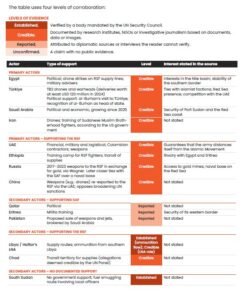
Their report offers a fascinating overview of the many international actors that are currently mingling in the conflict of Sudan, whereby foreign powers that are vicious rivals otherwise have ended up allying in Sudan.
As “primary actors”, the authors declare it is “credible” to list Egypt, Turkey, Saudi Arabia and Iran as being broadly allied with the Sudanese army. Iran would be engaged in training of Sudanese Muslim Brotherhood fighters, according to the US government. The report notes: “These four countries do not share the same agenda. Egypt and Saudi Arabia have long been hostile to the Muslim Brotherhood. Iran and Türkiye, instead, have ties with Islamist networks. What unites them is geopolitics more than ideology: the Red Sea, the Nile and the fear of an RSF-controlled state on their borders or on the opposite shore.”
About Saudi Arabia, the authors write that it “first presented itself as a mediator. It appears to have strengthened its support for the SAF after RSF drone strikes in 2025 on Port Sudan and the Red Sea coast. Riyadh considers these areas vital to its national security. Its support has taken the form of commercial and cooperation agreements with the Port Sudan authorities.”
In particular Turkey’s role is being described as “one of the best-documented cases. A Washington Post investigation revealed the delivery of eight drones and hundreds of warheads to the SAF procurement agency, which was already under US sanctions. The Turkish embassy in Washington says that Türkiye has refrained from any military support to the parties. In December 2025, President Erdoğan received al-Burhan in Türkiye.” To have a NATO ally apparently ignoring US sanctions is quite something. Then there is also a problem of leaky EU arms control, given “the presence within the RSF of European weapons sold to the UAE.”
On the other hand, there would be the United Arab Emirates, Ethiopia, Russia and China as countries that are directly or indirectly supporting the RSF.
The EFD report also lists “secondary actors” either supporting SAF (Qatar, Eritrea and Pakistan are at least “reported” to do so) or the RSF (General Haftar’s regime in Eastern Libya and Chad). South Sudan, which seceded from Sudan in 2011, would be engaged in fuel smuggling.
Not just state actors
On top of foreign state actors, there are also all kinds of Islamist networks active in Sudan. The EFD report recalls that “Islamist networks have been present in Sudan’s institutions, security services and army for decades. This explains their weight in the current war. To assess their influence on power and on the prospects for peace, the actors must be kept apart.
The label “Muslim Brotherhood” covers movements, parties and networks with a partly shared history, however their identities, leaders and interests differ. Treating them as one actor inevitably leads to wrong conclusions about who holds power and what they want.”
The authors thereby highlight: “On 9 March 2026 Washington designated the “Sudanese Muslim Brotherhood” as a Specially Designated Global Terrorist and announced its intent to designate it as a Foreign Terrorist Organization, effective 16 March 2026.
According to the US government, the organisation is composed of the Sudanese Islamic Movement, led by Ali Karti, and its armed wing, the al-Baraa Bin Malik Brigade. The designation lists both as aliases of the same organisation. The US government says it has supplied more than 20,000 fighters to the war, many of them trained or supported by Iran’s Islamic Revolutionary Guard Corps.”
The relevance for Europe
That Iran is engaged in the Sudan conflict should be of great concern for Europe, but yet the conflict is not exactly on top of the diplomatic list of priorities. The EFD reports that “for the EU, the US designation [of the Muslim Brotherhood as a terror group] matters for a practical reason. In 2024, the EU sanctioned Ali Karti, the leader of the Islamic Movement, for obstructing the democratic transition and ceasefire efforts. The US designation offers a model and a factual basis to move from sanctioning one person to targeting the Sudanese Islamic Movement he leads.
There are good reasons to take this step. (…) These networks weakened the civilian transition. Today they are among the main obstacles to peace, because a negotiated settlement and a civilian government would reduce their political and military power. As long as they can block an agreement, the war will continue. A longer war also has direct costs for Europe, in terms of humanitarian aid and migration.”
Given how migration remains one of the major priorities in European politics, this should give pause for reflection. As of August 2026, there were about 8.6 million internally displaced people in Sudan, according to the UN, as another 4.7 million have crossed into neighbouring countries since the war began, mostly into Egypt, South Sudan and Chad, but also to Libya, a gateway to Europe.
The authors thereby also highlight ongoing legislative EU initiatives to counter the Muslim Brotherhood, stating: “The political ground for such a step already exists in Europe. In January 2026 the French National Assembly called for the Muslim Brotherhood to be added to the EU terrorist list, and in March 2026 the lower house of the Dutch parliament called for a ban of the Brotherhood in the Netherlands. On 8 October 2026 the European Parliament called on the Council to include entities and individuals linked to the Brotherhood on the EU terrorist list, where the legal criteria are met.”
Last but not least, apart from tackling migration challenges and combatting Islamist fanaticism, Europe also has an economic interest in taking a closer eye at the conflict in Sudan, given how the country is lying at the shores of the Red Sea, that already beleaguered trade route which is crucial for supplies to Europe. The EFD academics note:
“Today, Sudan offers Iran a foothold on the African shore of the Red Sea, opposite Yemen, and a chance to extend its alliance network into Africa. With a presence on both shores, Tehran would have direct leverage over one of the world’s most important trade routes. The war between Iran, the United States and Israel, with the resulting closure of the Strait of Hormuz, showed the consequences of Iranian control over key trade and logistics hubs.
The main alternative route for Gulf oil passes through the Red Sea and the Bab el-Mandeb Strait, within range of Houthi missiles. The Red Sea is therefore not a separate route but the bypass for Hormuz. This means that if Tehran could count on an allied country on the African shore of the Red Sea, it would have an additional lever and could put pressure on two chokepoints at the same time.”
Given the impending new European energy crisis, this concern will only become more valid.