By Prof. Dr. Iur. Dr. rer. pol. h.c. Carl Baudenbacher, former President of the EFTA Court (2003-2017), Visiting Professor at the London School of Economics, Baudenbacher Law AG (Zurich/Oslo/Brussels) and Monckton Chambers (London)
Comments on the Icelandic referendum of 29 August 2026 on possible negotiations for accession to the European Union
Executive summary
Iceland withdrew its EU application in 2015. Speaking of „continuing” negotiations is therefore inaccurate. Any new process would be a restart, and Government and Althingi should be clear and transparent with voters on that point.
Claims that EU membership would significantly enhance Iceland’s security remain unsubstantiated. Iceland is a founding NATO member, and no concrete security gain from EU accession has been demonstrated.
The EEA/EFTA framework provides Iceland with full access to the internal market while preserving an independent institutional pillar. The EFTA Surveillance Authority and, crucially, the EFTA Court have repeatedly shown that they can enforce internal market law while taking proper account of the position of the small EEA/EFTA States.
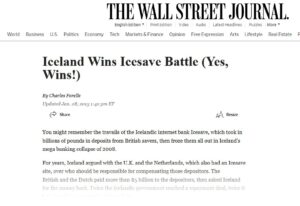
The Icesave case illustrates this clearly. Iceland prevailed. The dispute was decided by the EFTA Court, not the Court of Justice of the EU. This outcome supported Iceland’s economic recovery and ultimately led the Government to withdraw the EU application.
Remaining outside the EU preserves policy autonomy in sensitive areas such as fisheries, agriculture, foreign trade, and monetary policy—areas of particular importance to Iceland.
Finally, there are broader concerns about the EU’s current direction: increasing politicisation of the institutions, judicial expansion of competences, democratic deficits, and tensions with the freedom of expression. These developments merit careful reflection before any irreversible step is taken.
In conclusion, while much EU law already applies through the EEA in Iceland, the decisive safeguard is the independent EFTA pillar. EU accession would remove that protection. On this analysis, Iceland’s legal, economic, democratic, and sovereign interests may be better served by remaining within the EEA/EFTA.
Very clear explanation of why today's ruling on #Iceland's deposit insurance is a pretty big deal. http://t.co/PU4UiJA4 via @charlesforelle
— David Enrich (@davidenrich) January 28, 2013
In 2008, while the world rushed to bail out "too big to fail" banks, tiny Iceland did the unthinkable: they let their bloated banks collapse. The krona crashed 50%, protesters banged pots outside parliament, and economists predicted doom.
But here's the twist – Iceland recovered… pic.twitter.com/hgcNXsJdBK
— Handre (@Handre) February 12, 2026
I. Introduction
The Foreign Committee of the Althingi (Parliament of Iceland) invited me to provide comments on the referendum scheduled for 29 August 2026, on the question of whether Iceland should begin negotiations on the country’s accession to the European Union.
My thoughts are the following:
II. The proposal
The Althingi has decided that on 29 August 2026, the following questions shall be put forward to a referendum:
„Should negotiations on Iceland’s accession to the European Union be continued?
- Yes, negotiations on Iceland’s accession to the European Union should be continued.
- No, negotiations on Iceland’s accession to the European Union should not be continued.“
Iceland began negotiating membership of the European Union on 10 July 2010. In 2013, the negotiations were suspended, and on 12 March 2015, the application for accession was withdrawn. The Icelandic government emphasized that Iceland should not be considered a candidate country anymore. The EU Council took note of this. The use of the verb „continue“ gives the impression that the negotiations were never concluded. This is a semantic manipulation. The correct approach would be to ask whether the negotiations should be restarted.
One of the reasons put forward by supporters of Icelandic EU membership is the threat by US President Donald Trump to annex Greenland. Of course, this is a very emotionally charged argument. I cannot say how serious this threat is and whether it could be carried out. However, I have the impression that the political circles wishing for Iceland’s EU membership were already determined to pursue this goal earlier. Iceland is a founding partner of NATO, and I do not know whether the country’s security situation would significantly improve through EU accession.
III. The quintessence of the EEA Agreement
The starting point of considerations must be that Iceland has been, since 1 January 1994, a Contracting Party of the Agreement on the European Economic Area (EEA) within the EFTA pillar. As the first President of the EFTA Surveillance Authority, the Norwegian Knut Almestad, stated at the inauguration of the EFTA Court on 4 January 1994, that the EEA/EFTA States have their own independent EFTA Surveillance Authority and their own independent EFTA Court is the quintessence of the EEA Agreement[1].
As I see it, the EU accession application of 17 July 2009 was a consequence of the collapse of the Icelandic banks during the financial crisis of 2008. The corresponding decision was narrowly adopted in the Althingi with 33 votes to 28, with two abstentions[2].
The withdrawal of the accession application on 12 March 2015 was due, not least, to the realisation that the seminal Icesave (E-16/11 EFTA Surveillance Authority v. Iceland) case was won by Iceland because it was not the Court of Justice of the European Union (CJEU), but the EFTA Court that had jurisdiction. I presided over the case and was Judge Rapporteur. Therefore, I will refrain from giving an assessment. However, I point out that, for example, the renowned textbook of Damian Chalmers, Gareth Davies and Giorgio Monti criticised the EFTA Court’s Icesave judgment claiming that it went against the homogeneity principle. They hazarded a guess that the CJEU would, by relying on teleological reasoning, have concluded that the State concerned had to establish a robust deposit-guarantee scheme that would continue to function in a systemic crisis. The authors also called it „bizarre” that
„a supranational court is ruling on the allocation of costs following the effective bankruptcy of a state and financial system.”[3]
The CEO Magazine ran the headline:
„Iceland saved by EFTA.”[4]
Although the European Commission had done everything to force Iceland to accept the unfavourable Icesave Agreements with the United Kingdom and the Netherlands, the EU had no realistic possibility of questioning the outcome of the case. This was a direct consequence of the two-pillar model of the EEA and the institutional independence of the EFTA Court. Any subsequent dispute resolution procedure under Art. 111 EEA would have politically discredited the Union as a community of law.
The political and economic consequences in Iceland contradicted many contemporary forecasts. The ruling coalition was voted out, the devaluation of the Icelandic Krona accelerated economic recovery, and the responsible bank managers were charged, prosecuted and convicted. The assessment of the Central Banking Journal, that the judgment represented a „Pyrrhic victory” for Iceland,[5] turned out to be incorrect. Compared to Ireland, which as an EU and Eurozone member rescued its banks with substantial public funds, Iceland recovered significantly faster. By 2016, the United Kingdom and the Netherlands had received a full refund of all the taxpayer money spent on Icesave depositors from the bankruptcy estate of Landsbanki. The political conflict with the United Kingdom (the Gordon Brown Government had put the Icelandic Government on a list of terrorists) was settled, and Iceland’s EU membership application was withdrawn in 2015. The attempt to bring the strategically significant island into EU membership had thus failed.
The EFTA Surveillance Authority has also taken Icelandic sensitivities into account. Protocol No. 35 of the EEA Agreement, which establishes the primacy of implemented EEA law, has not been fully incorporated into Iceland law for decades. The EFTA Surveillance Authority has considered the Icelandic legal situation insufficient for all this time without taking decisive action.
The two other EEA/EFTA States too have profited from the existence of the EFTA pillar’s independent monitoring and court system.
The EFTA Court has repeatedly delivered judgments concerning Liechtenstein that can only be explained by a profound knowledge of national circumstances. A court without a Liechtenstein judge would presumably have assessed key aspects differently.
Thus, in the case of Dr Kottke (E-5/10), the EFTA Court held—contrary to the case law of the CJEU and against the position of the ESA and the European Commission—that the ordering of security for costs for a foreign plaintiff is unlawful only if it is disproportionate. This distinction was of considerable importance for the Liechtenstein financial centre.
In the joined cases Swiss Life and Vienna Life (E-15/15, E-16/15), the EFTA Court found that the trading of second-hand life insurance policies does not fall under the consumer protection rules of EEA law. Here too, the Court adopted a market-friendly position in the face of opposition from the ESA and the Commission.
Particularly influential was the recognition of the Liechtenstein trust in the cases Olsen (E-3/13, E-20/13). This was decided against the resistance of Norway, France and the United Kingdom. The CJEU later followed this approach in the Panayi case (C-646/15). The EFTA Court enjoyed a clear „first mover advantage” in this respect.
Finally, the case of Inconsult (E-4/09) demonstrated that the EFTA Court grasped technological developments earlier and more realistically than the CJEU. It recognised an internet website as a possible „durable medium”, thereby adopting a modern image of man. Here again, the EFTA Court was able to set the pace for the CJEU (C-49/11 Content Services).
Norway bears the bulk of the costs of the ESA and the EFTA Court and systematically asserts its interests at several levels. It takes advantage of the fact that there is no written obligation for courts of last resort to refer cases to the EFTA Court and that preliminary rulings formally constitute advisory opinions. There is currently a debate as to whether the Norwegian Supreme Court should implement the judgment of the EFTA Court on the applicability of EEA law to the continental shelf (E-6/25 Saga Subsea).[6]
The concept of „room for manoeuvre,” developed by the Norwegian State Attorney, aims to assert state discretion vis-à-vis EEA law, even when this is to the detriment of private individuals and economic operators.[7]
This practice is illustrated exemplarily by the so-called Norwegian Waterfalls case (E-2/06). The traditional reversion („hjemfall”) system, which served to maintain public control over hydropower resources, was held by the EFTA Court to be incompatible with the fundamental freedoms. The Icelandic Judge, and later Chief Justice of Iceland, Thorgeir Örlygsson was the Judge Rapporteur. While the Court recognised security of energy supply and environmental protection as legitimate objectives, it nevertheless considered the means chosen to be disproportionate.
From the perspective of state sovereignty over energy resources, Norway responded with considerable political skill. Instead of abandoning the system, it strengthened public ownership and largely excluded private investors. After doubts, the EFTA Surveillance Authority accepted this solution. Owing to the two pillar-system, the European Commission lacks any possibility of taking independent action against Norway.
The examples presented show that, for the small EEA/EFTA States, the independent organs of the EFTA pillar are not merely a formality but a central instrument for safeguarding national particularities. Their proximity to the legal systems of the EEA/EFTA States, their institutional independence, and the two pillar-model make it possible to arrive at solutions that would not be achievable in the EU system. It is important to note that this has also be recognized by the EU. On the EFTA Court’s thirtieth years anniversary, the President of the CJEU, Koen Lenaerts, has nevertheless praised the good functioning of the two-pillar system and emphasised that it is based on „mutual trust”.[8]
Following EU accession, Iceland would probably be entitled to nominate a member of the European Commission and a judge to the CJEU. For those appointed to such positions, this could undoubtedly be seen as a personal or professional advantage. Whether, however, these institutional gains would serve the broader interests of the country remains open to question. The principle of equality of the Member States applies only to a limited extent.
IV. Non-participation in the EU’s Common Policies
The second major advantage offered by the EEA Agreement is the fact that the EU’s common policies have not been taken over by the EEA/EFTA States. This refers to agriculture, fisheries, foreign trade, foreign policy, and currency.
Although I, as an EFTA Court judge, have dealt with important cases concerning fisheries, and as a judge and after my resignation, addressed problems of Icelandic agriculture, I think that I should not make long explanations regarding this. The Icelanders know better than I do what they gain from the absence of the EU’s Common Agricultural Policy and Common Fisheries Policy in the EEA Agreement.
In 2009, when the then Icelandic government applied to join the EU, the decline of the Icelandic Krona after the downfall of the Icelandic banks played a role. In the meantime, the Euro has continuously lost value, while the Krona is quite strong. Monetary policy is not my field. But one thing seems clear: The Euro is a weak currency and is likely to remain a weak currency.
V. EU Crises
When the EFTA States decided in 1989 to embark on the European Economic Area project, the EU was an attractive bride. In 1985 it had launched its Single Market programme. Today, the EU appears to have passed the zenit.
Since the 2000s, the EU has stumbled from one crisis to the next. These crises have undermined trust and hindered further integration. Several events are cited as turning points that eroded confidence in the EU and obstructed further integration:
The rejection of the European Constitution in referenda in France and the Netherlands in 2005 marked a turning point that dampened EU enthusiasm. Significantly, in these states no further vote was held on the Lisbon Treaty, even though the latter is remarkably similar.
The financial and Euro crisis from 2008 onwards hit economically weaker states particularly hard and put the European Union to a severe test—a challenge that could only be overcome through extensive and expensive rescue packages.
The refugee crisis (from 2015 onwards) remains unresolved.
The decision of the United Kingdom to leave the EU marked the first-ever withdrawal of a member state. Despite all the propaganda from Brussels, and although the EU did everything it could to make life difficult for the British, this represents a significant turning point. The late Czech Foreign Minister Karel Schwarzenberg described the UK’s exit from the EU as a „political catastrophe.” Without the UK, he said, the EU will be „a bleak sight,” because it will „lack the English way of thinking”, specifically „the joy of contradiction.”
„I think a Europe that, to put it harshly, is determined by French centralism but carried out with German thoroughness, fills me rather with horror.”[9]
The record of achievements of the von der Leyen Commission shows that Schwarzenberg had a point.
VI. Politicisation of the European Commission
The traditional understanding of the European Commission as the „guardian of the treaties” has long given way to an increasing politicisation. Already upon taking office in November 2014, President Jean Claude Juncker stated that he wanted a political Commission. Later, he demanded that the EU must become capable of acting on the global stage. While the latter remained wishful thinking, the internal politicisation of the Commission is a reality.
This development comes at the expense of the rule of law and predictability. EU law is not applied equally to all member states. An instructive example was provided by Juncker in 2016, when asked why France was treated leniently despite ongoing violations of the Stability and Growth Pact. He briefly replied: ‘Parce que c’est la France’ (‘because it’s France’). Brussels journalist Gabriel Grésillon correctly commented that this ‘joke’ was poorly received by all those who view French budget laxity as the core of the European problem.[10]
The episode illustrates a structural connection: opportunism displaces commitment to rules.
After the suspension of the EU budget rules during the COVID-19 pandemic (2020–2023), hopes were raised that the Commission would take tougher action against deficit offenders under the reformed framework. In fact, in June 2024 it initiated excessive ‑deficit‑ procedures against seven states. Nevertheless, Werner Mussler from the Frankfurter Allgemeine Zeitung rightly warned against exaggerated expectations. Today the Commission enjoys even greater discretionary powers, while deficit procedures have become largely ineffective.[11]
Albert Steck from the Neue Zürcher Zeitung likewise observed that the Stability Pact is effectively in a coma. The dilution of Germany’s debt brake and the renewed suspension of the budget rules in favour of rearmament continue a familiar pattern: political challenges are answered with new debt, undermining citizens’ trust and weakening the credibility of the euro.[12]
At the same time, the Commission is performing its core task—ensuring the internal market—only selectively. According to the Financial Times, infringement proceedings fell significantly between 2020 and 2022.[13] Important market access barriers persist, especially in countries such as France, Germany, Italy, Poland, or Hungary, for example in the services sector. Despite complaints, the Commission remains passive here. By contrast, it is particularly active in enforcing free movement of persons and residence rights for third‑country nationals – areas that are not central to the functioning of the internal market and that point to an ideological prioritisation.
Under Ursula von der Leyen, this tendency has intensified. Politicisation has meanwhile also reached the legal services of the Commission and the Council.
1. „Consiglieri”[14]
The former EU Ombudsman Emily O’Reilly compared the environment around the Commission President to the advisers of mafia bosses—a drastic but symptomatic image of the opacity and concentration of power within the Commission.
2. NGO scandal
In June 2025 it became known that since 2021 more than €7 billion in EU funds had flowed to NGOs, in some cases for campaigns and lawsuits against EU companies. Contracts document coordinated public relations work and targeted lobbying activities.[15]
3. Allegations of corruption
A Politico article by Mari Eccles in the same year described a widespread culture of impunity within the EU. Despite numerous affairs, there were no personal consequences. National governments are subject to democratic oversight; the EU Commission, by contrast, evades political accountability.[16]
This diagnosis is confirmed by a report from the European Public Prosecutor’s Office. According to an article in the Süddeutsche Zeitung of March 2026, EU funds are disappearing into criminal channels at record levels—and the trend is rising.[17]
4. Accusation of authoritarianism
The former EU Commissioner Michel Barnier and EU Brexit Chief Negotiator accuses von der Leyen in his 2025 book „Ce que j’ai appris de vous“ („What I have learnt from you“) of an increasingly authoritarian leadership style. The Commission is narrowly technocratic, political exchange and listening are neglected.[18]
A current example is von der Leyen’s statement on the third Gulf War in March 2026, in which she publicly called for a „credible transition“ in Iran – despite lacking EU competence and contrary to the line of the foreign ministers of the Member States.[19]
The Commission increasingly sees itself as the government of the EU, while the EFTA Surveillance Authority acts as the guardian of the EEA Agreement.
5. Restriction of freedom of expression
The tightening of the enforcement of the Digital Services Act raises significant fundamental rights issues. Vague terms such as „hate speech“ or „disinformation“ favour overblocking and indirect censorship.
A report by the Justice Committee of the U.S. House of Representatives from February 2026 makes serious allegations against the EU. According to it, the Commission had already systematically exerted pressure on platforms to tighten moderation rules before the DSA came into force – with global effects („Brussels Effect“).[20] Critical content, especially during the Corona pandemic and before elections, was disproportionately affected.
Criticism of the restriction of freedom of expression in the EU does not come only from the Republican-controlled U.S. House of Representatives. It also comes from the former judge at the Court of Justice of the European Union, Prof. Dr. Ninon Colneric, who is close to the German Social Democratic Party SPD. Together with the French Professor Alina Miron, she has evaluated the policy of the Council and the Commission to sanction individuals for mere expressions of opinion about the reasons for the Ukraine war and has concluded that it is illegal.[21]
6. The Narrative of the „Rule-Based“ European Union
The EU claims for itself to be the main protagonist of a rule-based world order.[22] On closer inspection, this narrative proves to be inconsistent. The European Union only selectively adheres to its own central rules – from the Maastricht criteria which ensure that a country’s economy has a high degree of price stability to migration law. Towards third countries, notably Switzerland, the EU openly pursues power politics. Even EEA/EFTA States like Norway and Iceland are now affected by trade policy protective measures in the field of ferroalloys – contrary to previous practice and in my view clearly illegal.[23] Experience shows that a reliable rules-based policy is not guaranteed by the EU. That can also be a problem for small member states.
7. The Narrative of the „European values“
The EU leadership unceasingly and in a pervasive manner emphasises how strongly the Union is committed to noble values. This amounts to propaganda intended to conceal the fact that matters are not always going well. It is even argued that this constant self-congratulation serves to mask the absence of such merits. There is said to be a discrepancy between the proclaimed values and political and judicial practice. Nobel prize winner in literature Peter Handke has written:
„All the tender, profound values of humanity are everywhere. The values are in the forms of the great works. The values are in the sobbing of a child. Or in a child’s skipping step. European values? […] Whoever wishes may make a living from them, or play with them, or sing them, or paint them; but he should stop turning European values into an axe against others. People who speak like that are the new rabble.“[24]
German journalist and media entrepreneur Gabor Steingart commented on this as follows:
„The Nobel Prize laureate for literature Peter Handke, widely unpopular because of his political bluntness, was right. The almost religious emphasis on and chanting of ‘European values’—which in Brussels belongs to the shared morning devotions of parliamentarians and EU bureaucrats—is a new form of superiority now perceived as supranational. […] The fact is: Freedom, the rule of law, and freedom of expression —are preached on Sundays and disregarded on weekdays.
‘The world needs more Europe,’ says Ursula von der Leyen. She sees herself as the secular head of a community of values. She believes that, in the evolutionary history of humankind, today’s Europe is the crowning achievement of creation.“[25]
VII. The methodological approach of the CJEU
The CJEU has developed its own methodology of legal interpretation. The starting point is the wording of a norm, then come the legislative history, the purpose (telos), and the systematic context. There is no fixed hierarchy among these interpretative criteria. The CJEU, however, regularly accords priority to the principle of effet utile: provisions are to be interpreted in such a way that the objectives of the Treaties are realised as effectively as possible. The wording does not constitute an absolute limit, and historical interpretation plays a subordinate role. This approach implies a pronounced willingness to engage in judicial law‑making.
As an institution of the EU, the CJEU is bound to the objective of an „ever closer union.” This structural goal‑orientation has led to a progressive politicisation, which began as early as the 1960s with the landmark judgments Van Gend en Loos (C-26/62), Costa v ENEL (C-6/64), and Francovich (C-6/90). Through the judge‑made development of direct effect, the primacy of EU law, and state liability, the EEC Treaty was in practice reshaped in a quasi‑constitutional manner. Owing to the requirement of unanimity for Treaty amendments, political correction of the Court’s case law is hardly possible.
Institutional factors relating to composition and working methods reinforce these tendencies. At the time of their appointment, many judges come from national public administration or EU institutions and lack prior judicial experience. The absence of an automatic case‑allocation system, the significant role of the Judge‑Rapporteur, and the strong influence of the référendaires (legal secretaries) contain political elements. The style of judgments is apodictic; transparency is further reduced by the absence of an open voting and dissenting opinion system.
Methodologically, teleological interpretation predominates. The multilingual nature of legal acts and the claim to autonomous interpretation mean that the wording usually serves only as a starting point. Systematic and teleological considerations regularly override it. The concept of „system” is applied flexibly, ranging from individual legal acts to the entire EU legal order. The boundary between interpretation and gap‑filling is fluid; the CJEU acknowledges gaps and fills them in the light of the objectives of the Treaties. In this way, the Court becomes a driving force of European integration.
The former Justice of the German Constitutional Court Dieter Grimm has famously stated:
„The CJEU is freer than any national court.”[26]
This methodological independence is particularly evident in politically sensitive cases, for example concerning the legal status of in‑house counsel, euro‑area rescue measures, gambling law, energy law and migration policy, the German passenger car toll, or most recently the move of the CJEU to put its hand on the right of the member states to decide on the granting of their own citizenship. In several cases, the CJEU has been accused of Europeanising competences without a clear legal basis and of encroaching upon core areas of national sovereignty.
Overall, the CJEU operates in a field of tension between national legal orders and supranational law. Its teleologically oriented methodology, the institutional framework, and its political goal‑orientation (Article 13 TEU) confer upon it an exceptional degree of shaping power.
VIII. Democratic deficit
As far as the well-known democratic deficit is concerned, I limit myself to citing two famous authors:
In 2011, the German poet and author Hans Magnus Enzensberger wrote:
„As if the constitutional struggles of the 19th and 20th centuries had never existed, the Council of Ministers and the Commission agreed right from the founding of the European Community that the population has no say in their decisions […]. It is also disruptive that the peoples who invented European democracy, such as the British and the Swiss, apparently find it difficult to part with this form of government. That is why the leaders in Brussels, Strasbourg, and Luxembourg have devised a strategy designed to make them immune to any criticism. Anyone who opposes their plans is denounced as anti-European.“[27]
Italian sociologist Luciano Gallino stated:
„Is the European Union a democracy? Judging by recent years, we should answer no. It appears as an increasingly despotic regime, capable of violating not only the same treaties that establish it but even – with the collaboration of the International Monetary Fund – human rights. […] It seems evident that the EU has ceased to be a democracy, increasingly resembling a de facto dictatorship.“ [28]
IX. Conclusion
Complaints about the EU’s preference for bureaucracy and regulation are legion. The Justice Minister of the former German traffic light coalition, the lawyer Marco Buschmann, presented a plan against excessive bureaucracy in April 2024, which contains ten points against the rules from Brussels. In 2023 alone, around 2,300 legal acts were enacted at the EU level, costing companies a lot of time and money. In the European election campaign of spring 2024, numerous candidates accused the von der Leyen Commission of having lost all sense of proportion when it comes to bureaucracy.[29]
It is estimated that around 75% of EU internal market law is incorporated into EEA law. But even if the EEA/EFTA States are thereby imposed with regulation that is not competition- and innovation-promoting, the essence of the EEA Agreement remains: the existence of an independent EFTA Surveillance Authority and an independent EFTA Court. That would no longer be the case if Iceland joined the EU.
It is natural that the European Commission in the current situation is sounding fanfares about how quickly and smoothly Iceland can become an EU member. However, one should not forget that the Commission has made matters difficult for Iceland after the banking collapse by putting pressure on the country to accept the Icesave agreements with the United Kingdom and the Netherlands. This would have meant that the Icelandic state acknowledged responsibility for the bankruptcy of private banks. The Commission could not bring proceedings against Iceland under the two-pillar structure of the EEA Agreement. It was the EFTA Surveillance Authority that brought the case. However, the Commission did not limit itself to participating in the proceedings. For the first time in the history of the EEA, it acted as an intervener. The Commission wanted to make it clear that it took the matter seriously. Commissioner Michel Barnier wrote to the Icelandic Minister of Finance Steigrímur J. Sigfússon that he was not aware of any comparable situation in which depositors had not been compensated.[30] This means that the Commission sided against Iceland during the country’s EU accession talks. Many observers predicted that Iceland would have gone bankrupt if it had lost the case before the EFTA Court.
One can say that Iceland’s way of responding to the crisis was economically superior to the EU’s policy, which was based on the belief that bailing out failed banks was the right thing to do. However, this was only possible because Iceland was not a member of the EU.
[1] Report of the EFTA Court 1 January 1994 – 30 June 1995, p. 177, Available here: Report-1994-01-01-1995-06-30.
[2] See Torsten K. Schreiweis, Island und die Europäische Union. Eine Studie zur zur Erweiterung, Vertiefung und Integration der EU, Ph.D. Thesis Bonn 2018, and my review in Common Market Law Review 2023, Available here: Book Review: <i>Island und die Europäische Union: Eine Studie zur Erweiterung, Vertiefung und Integration der EU</i> Edited by Thorsten K. Schreiweis. (Baden-Baden: Nomos, 2021) – Kluwer Law Online.
[3] Chalmers, Damian, Gareth Davies, and Giorgio Monti. European Union Law: Text and Materials. 4th ed. Cambridge: Cambridge University Press, 2019; see also Chalmers, Icesave – limited homogeneity and unlimited judicial interpretation. In Baudenbacher, C. (Ed.), The EEA and the EFTA Court (pp. 407-417), 2014.
[4] Europeanceo.com: Iceland saved by EFTA – Iceland wins Icesave EFTA case, (undated), Available here: https://www.europeanceo.com/finance/iceland-saved-by-efta/.
[5] Tim Young, Efta court’s Icesave ruling leaves European deposit insurance in tatters, 31 January 2013, (Centralbanking.com), Available here: Efta court’s Icesave ruling leaves European deposit insurance in tatters – Central Banking.
[6] Schjødt law firm newsletter: Saga Subsea – EFTA Court advisory opinion: EEA law applies to the Norwegian Continental Shelf, March 5, 2026, available here: EFTA Court advisory opinion: EEA law applies to the Norwegian Continental Shelf – Schjødt.
[7] See f.ex. Chapter 6 Room for manoeuvre: participation, influence and adaptation (Handlingsrom: medvirkning, påvirkning og tilpasning) in the White Paper (NOU) 2024:7 Norway and the EEA: Development and experiences (Norge og EØS: Utvikling og erfaringer) available here: https://www.regjeringen.no/no/dokumenter/nou-2024-7/id3033576/?ch=7 (English translation of summary here: https://www.regjeringen.no/en/documents/nou-2024-7/id3033576/).
[8] Koen Lenaerts/Stanislas Adam, “The Foundations of the EFTA Court: Looking Back at the Two EEA Opinions of the Court of Justice”, in The EFTA Court. Developing the EEA over Three Decades, 2024.
[9] ČTK News Article, “Schwarzenberg: Brexit is a political disaster. The EU will miss British thinking” (my translation), September 3, 2016, (lidovky), Available here: https://www.lidovky.cz/domov/schwarzenberg-brexit-je-politicka-katastrofa-eu-bude-chybet-britske-mysleni.A160903_212258_ln_domov_rsa.
[10] Gabriel Grésillon, «2017 Budget: the European Commission remains vigilant but is relatively confident» (Budget 2017 : la Commission européenne vigilante mais relativement confiante), September 28, 2016, Les Echos, available here: https://www.lesechos.fr/2016/09/budget-2017-la-commission-europeenne-vigilante-mais-relativement-confiante-218998
[11] Werner Mussler, „So nutzlos wie eh und je“, Available here: https://www.faz.net/aktuell/wirtschaft/eu-stabilitaetspakt-defizitverfahren-sind-nutzlos-19800127.html.
[12] Albert Steck, „Schluss mit der Maastricht-Lüge: Europa braucht jetzt einen Euro, dem die Leute vertrauen. Und nicht noch mehr Schulden“, Available here: Europa braucht starken Euro statt Schulden: Schluss mit der Maastricht-Lüge
[13] Alice Hancock / Andy Bounds, “Brussels too slow to tackle trade abuse by member states, say industry bodies”, January 13, 2025 (Financial Times), Available here: https://www.ft.com/content/c3e32aec-ab1e-4654-9ca2-8d31cba023ff?syn-25a6b1a6=1.
[14] Sarah Wheaton and Sebastian Starcevic, “‘Powerful consiglieri’ run von der Leyen’s Commission, EU transparency chief says”, December 20m, 2024 (Politico), Available here: https://www.politico.eu/article/consiglieri-ursula-von-der-leyen-eu-commission-cabinet-ombudsman-emily-oreilly/.
[15] See e.g. Pieter Cleppe, “The Brussels NGO scandal continues to expand”, July 29, 2025 (Brussels report), Available here: https://www.brusselsreport.eu/2025/07/29/the-brussels-ngo-scandal-continues-to-expand/.
[16] How the EU always gets away with it, Available here: https://www.politico.eu/article/european-union-corruption-pfizergate-ursula-von-der-leyen-impunity/.
[17] Betrug mit EU-Geldern. EU-Ermittler warnen vor Europas „krimineller Industrie“, available here: https://www.sueddeutsche.de/wirtschaft/eu-gelder-betrug-korruption-rekord-li.3396268?reduced=true.
[18] Michel Barnier, Ce que j’ai appris de vous, see e.g.: https://www.fnac.com/a21381952/Michel-Barnier-Ce-que-j-ai-appris-de-vous.
[19] Joe Stanley-Smith, EU chief von der Leyen calls for regime change and shift to democracy in Iran, March 1, 2026, Available here: https://www.politico.eu/article/ursula-von-der-leyen-regime-change-democracy-iran/.
[20] U.S. House of Representatives, The Foreign Censorship Threat, Part II: Europe’s Decade-long Campaign to Censor the Global Internet and How It Harms American Speech in the United States,
Interim Staff Report of the Committee on the Judiciary of the
U.S. House of Representatives, February 3, 2026, Available here: https://judiciary.house.gov/sites/evo-subsites/republicans-judiciary.house.gov/files/2026-02/THE-FOREIGN-CENSORSHIP-THREAT-PART-II-2-3-26.pdf.
[21] Ninon Colneric / Alina Miron, Legal Opinion Commissioned by Michael von der Schulenburg and Ruth Firmenich, non-attached members of the European Parliament, October 31, 2025, Available here: https://bsw-ep.eu/wp-content/uploads/Rechtsgutachten_Sanktionen_gegen_natuerliche_Personen_BSW_von_der_Schulenburg_Firmenich.pdf
[22] See e.g. Churchill Lecture / Kaja Kallas (High Representative of the Union for Foreign Affairs and Security Policy and Vice-President of the European Commission), “A Rules-Based Order in an Era of Power Politics”, March 5, 2026, at Universität Zürich, Available here: https://www.eiz.uzh.ch/product/kaja-kallas-high-representative-of-the-union-for-foreign-affairs-and-security-policy-and-vice-president-of-the-european-commission/.
[23] David Bach, «Tidligere EFTA-topp: – EU har skutt seg selv i foten» («Former EFTA-leader: The EU has shot itself in the foot»), E24 Financial News, November 19, 2025, Available here: https://e24.no/norsk-oekonomi/i/vrWWyX/tidligere-efta-topp-eu-har-skutt-seg-selv-i-foten.
[24] Peter Handke, “Peter Handke on ‘European Values’”, August 7, 2022, Available here: https://adpunktum.de/2022/07/08/peter-handke-zu-europaeischen-werten/, my translation.
[25] Gabor Steingart, „Europäische Werte? Wie sich die EU unter von der Leyen selbst demontiert“, July 8, 2022, Available here: https://www.focus.de/politik/gastbeitrag-von-gabor-steingart-europaeische-werte-wie-die-eu-sich-selbst-demontiert_id_112544834.html, my translation..
[26] Bundestag archiv: „Autorenlesung: Dieter Grimm fordert ein „besseres“ Europa“, 2016, Available here: https://www.bundestag.de/webarchiv/textarchiv/2016/kw48-lesung-grimm-482804#:~:text=%E2%80%9EDer%20EuGH%20ist%20freier%20als%20jedes%20nationale%20Gericht.%E2%80%9C,EuGH%20eingeschlagenen%20Richtung%20der%20Integration%20etwas%20zu%20%C3%A4ndern.
[27] Von Hans Magnus Enzensberger, „Sanftes Monster Brüssel“, Der Spiegel 9/2011 dated 27 February, 2011, (my translation), Available here: https://www.spiegel.de/kultur/sanftes-monster-bruessel-a-96fc1f36-0002-0001-0000-000077222640.
[28] Gabriele Guzzini, Facebook post of January 19, 2026, (my translation), Available here: https://www.facebook.com/gabri.guzzi/photos/lunione-europea-%C3%A8-una-democrazia-a-giudicare-dagli-ultimi-anni-dovremmo-risponde/1476579134475571/.
[29] Von Florian Schmidt, Plan gegen EU-Bürokratie – “Diesen Trend müssen wir stoppen”, t-online, July 16, 2024, Available here: https://www.t-online.de/nachrichten/deutschland/innenpolitik/id_100391512/marco-buschmann-legt-zehn-punkte-plan-gegen-buerokratie-burnout-vor.html.
[30] Letter of 17 August 2010, Available here: https://www.stjornarradid.is/media/fjarmalaraduneyti-media/media/frettir/barnier-svar.pdf.
Disclaimer: www.BrusselsReport.eu will under no circumstance be held legally responsible or liable for the content of any article appearing on the website, as only the author of an article is legally responsible for that, also in accordance with the terms of use.